The Phantasmagorical Clarence John Laughlin

Just saw this marvelous tale at the Prytania Theater during the 2015 NOFF about local boy-made-good Clarence John Laughlin, known as the father of surrealist photography, writer and significant mid-century book collector.  It’ll make you want to pore through the collection at HNOC, check out this current exhibit and to purchase his book Ghosts Along the Mississippi. What I loved about the movie was the frank appreciation among his fellow artists for his talent, mostly accompanied by shrugs about his particular way of existing in the world. That regard from peers is quite poignant, especially when compared to the barely-hidden impatience of the curators interviewed or talked about in regards to his manner of interacting with them. It sheds some cruel light on the difficult lives that artists fashion for themselves when they rightly refuse to be in step with their times and are forced to fight against the process necessary to be “successful.” Throughout the movie, the words “enigmatic” and “genius” are heard as much as “irascible” and “difficult.” That might give you a clue. In cases like Laughlin, you can see how that protectiveness can become destructive to the person and to their legacy, and is illustrated by the alternatively hilarious and painful video interspersed of Laughlin and the creator of the documentary, Gene Fredericks, attempting (unsuccessfully it turns out) to get footage back in the 1970s of the artist talking about his book collection..

New media artist Dawn Dedeaux, also an extremely well-regarded New Orleans artist, captures him best with humor and sensitivity in her comments in the film. In essence, she says time marches forward unceasingly, but Clarence was always headed in the other direction….

…and that she’d love for him to haunt her as a ghost-I totally agree.

The many Laughlin photographs that Fredericks labored to get in the movie (bartering his videographer talents to offset the fees) give the viewer a stunning understanding of his artistic eye. Each photo chosen could easily have lingered on the screen for many seconds more to view them from corner to corner and then drawing back, to see the entirety…but as they say, if you like what you see, then buy the book. The text that Laughlin wrote to accompany each photo and the quotes in the film about artistic choices all seem quietly wise and necessary to understand his vision.

It seems to me that Laughlin could have only lived in New Orleans in the time that he did to become a great artist, but might have been happier at other times in history, even if it meant being a less realized artist. Especially if it was in those lovely days when fame was not a goal in itself and when having deep eccentricities and an uneven personality was not necessarily a deal killer to being deemed worthy of review or respect.

Even so-as one autodidact to another, I salute you Clarence.

Membership – Krewe de Jeanne d’Arc

One of the best parades and since it’s a walking parade through the Quarter, it is doubly special. January 6th is the Feast of the Epiphany and the kickoff day for Carnival each year. It is also Joan’s birthday, so the parade is one of two that revelers can enjoy, along with the Phunny Phorty Phellows’ streetcar parade.

This krewe has open membership and has slots open now for the 8th annual Joan of Arc Parade January 6, 2016. Two types of membership: Full Members: Full members “Officers” walk in the parade portraying medieval French townspeople and characters associated with Joan’s story.

Source: Membership – Krewe de Jeanne d’ArcKrewe de Jeanne d’Arc

Money is the crop.

Capitalism
Is the plantation owner
Money is the crop

My wise friend Peter’s daily haiku is the perfect way to start off a post about a recent opinion piece posted on The Lens that I link below. The writer is leaving after 5 years here and gives us his opinion on us before he hightails it to higher ground. So many people are like the opinion writer Sam and don’t even see themselves as wage slaves or ever sharecroppers living on the scraps allowed by their owner. And maybe they do know this but won’t admit to it- that they’d throw everything of real value over the side of the boat if they could paddle faster to the gold they seek.

Following that link is my response that I wrote to young Sam, who I have taken to task before (poor Sam). It’s on the site but comment section sometimes get lengthy and the newest are most easily found, so I stuck it here too.

Opinion

And my response to it:

Entertaining as usual, but I not surprised that this writer once again lays the core impulse of his youth on external issues. He did it in his job seeking column and does it again here. Sam, you write well, yet with a great deal of self-importance and either a lack of understanding about systems or for self-preservation’s sake, using a disingenuous style of discovery, neither of which is gonna fly here. Here is the thing Sam; The truth is that young white Northerners like yourself are searching for something that small Southern port towns cannot give you and have never promised to give you. Full disclosure: I was once one of you; yes I have a New Orleanian parent and generations of family here and can join in the high school naming game but I had an out. Being partially raised up North in a small suburb that was (back then) lily-white and clean as hell meant I had experienced another life. And so at one point, I bolted from here, telling my family and friends a whole bunch of reasons why I left, but the truth was, I needed more than New Orleans could offer. Simply that I needed more and knew that in places with industry and middle-class comforts, I could get them. The difference is I knew I would come back to live among family and that the pull of the diverse culture for me would be to much to block out after some years; I was right about that (after a dozen years away), I came back to stay. So i get the impulse, but own up to your decision that is being done for reasons that are not to do with New Orleans really but to do with your ambition for things not offered in towns like ours, a restlessness of youth, and discomfort with the way a colony operates – all fine by the way. To talk (on a news site read by locals) about festivals, and wild partying shows the visitor in you even after your five years. Those things never keep anyone here. You didn’t talk about the families lining the parade routes and the multi-generational celebrations within neighborhoods and the blue-shirted men who are the heart and soul of their workplace and the St. Joseph altars and the purple light at night in the sky…
I can see that both of us romanticize the place and so I’m no better, but do us one a favor – tell the complete story when you go and not just tales of your “exploits” of staying up all night, of drive-thru daiquiris and “knowing” Kermit. New Orleans bides in a state with a misanthropic governor, a non-existent regional system and has to withstand waves of new people that come to extract value and comment on our pitiful existence and, somehow, rises above it still with a great deal of grace. It has a problem with race as does every American city (including the one I grew up next to in my suburb and yours too) and it does have widespread corruption and commodity industries that do not support creativity or informality, also like other cities. Some of them have “solved” some of that by pushing out those without enough resources rather than offering a hand or by criminalizing things like homelessness. Other cities focus on attracting virtual industries that allow their workers to live in a bubble, high above the mean streets, without the regular interaction necessary when you have a physical job to go to and work at among neighbors. What has to happen to fix these systems is embedding yourself in it, fixing it by being present and by being open to the new and the old and finding what works best from either and both and talking openly about all of it. I’m not saying we have accomplished any of it, but the opportunity remains for it to come to fruition as long as we commit to being here.
I wonder if you ever really meant to stay, ever really committed yourself to the place where people like you (and me) are minorities and our talents are not that useful. Because that is what I suspect is true among your peers; you were always meant to go and so you cannot blame us for knowing that and not offering you the golden ring you seek. Good luck in your search and thank you for your kind words for us during your stay. Tell the rest that we’ll stay as long as the water can be contained, because we can’t go anywhere else.

A site devoted to tracking the goodbyes: http://fleur-de-leaving.tumblr.com/

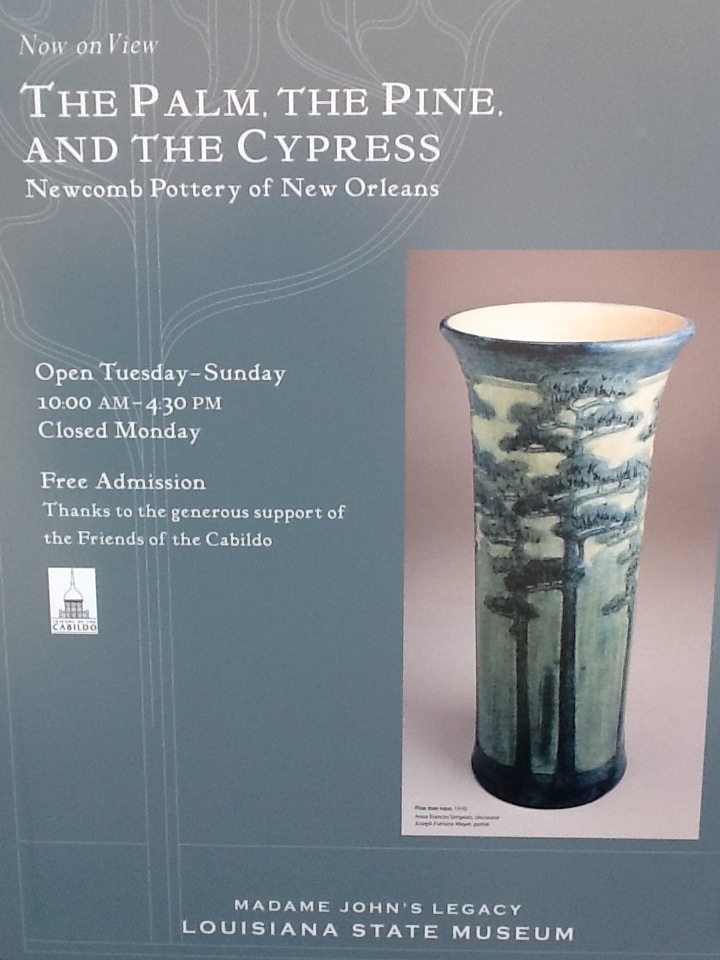
Newcomb Pottery exhibit

Update for 2015:  Still up as an exhibit; if you haven’t seen it, I recommend it heartily. And now you can have lunch afterwards at Petit Amelie right across the street, which is the most beautiful cafe in the Quarter.

(original 2012 post)
Over a sunny lunch hour, I dragged my 1970s Crescent folding bike out from behind the lawnmower (been raining a lot lately is my only excuse) and headed to the Quarter.
After a delightful lunch at Stanley’s-well except for the wait staff’s obsession with their new iPhones, although I think a very good idea to have them for taking orders. The real issue today was the less than stellar bar staff but  I’m still loyal to this chef and his wife, so stayed for a cherry-limeade Italian soda and a bowl of their gumbo with potato salad dumped in and was glad I did.

Afterwards, I unlocked the Crescent and headed to Dumaine, between Chartres and Royal.
Madame John’s Legacy is said by some to be either the oldest or the second oldest building in the Quarter. Ursuline Convent is usually considered to be the oldest and since MJL burned in the first fire that swept through the Quarter and had to be rebuilt, I’m not sure why some fight for the oldest designation.
Okay, maybe its just wild talking mule carriage drivers that say that. I am also sure that the many expert historians could make a case for either if needed.

In any case, it has to be the plainest building in the Quarter.

I like that about it, but it must be hard for people to believe its a museum with its undecorated green front (historically accurate colors by the way) and its entrance at street level under the stairs. As locals know, the gingerbread and vibrant colors came with that nutty Victorian age. The name itself comes from a George Washington Cable story, a writer interestingly, who worked in part of the same time period as the Newcomb Pottery folks and was known for his sympathetic and sensitive portrayal of the complex culture found in New Orleans.
Once you get upstairs, a very courteous security officer at the desk gives a short overview of the fact that this exhibit is free (thanks to the Friends of the Cabildo, you’re very welcome) and that pictures are allowed.
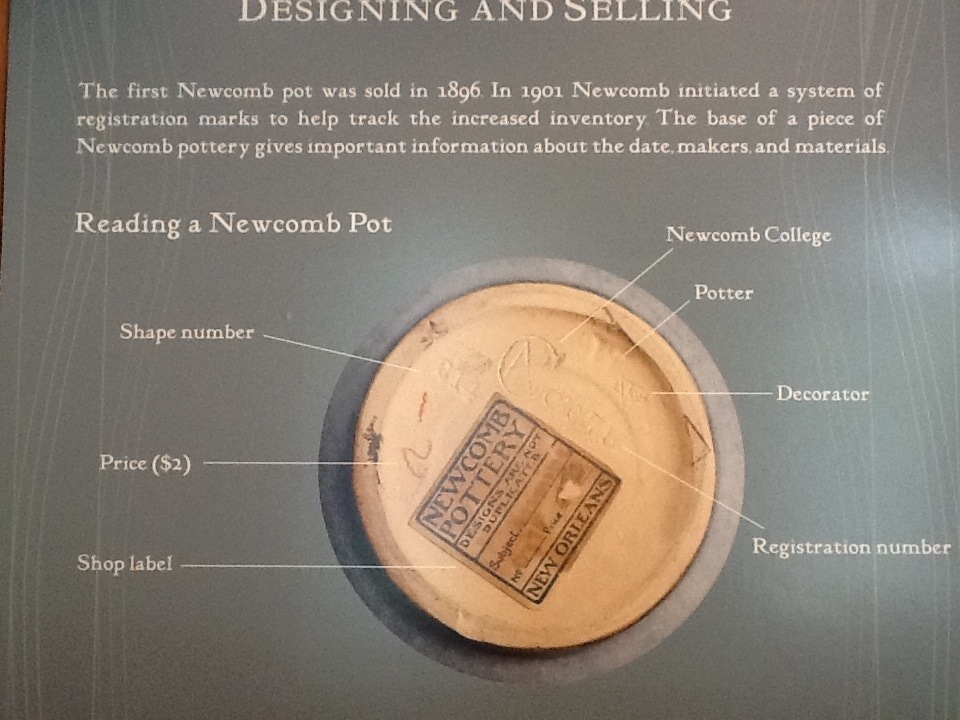
I was the only person in there until the end when a couple of French men came in and went directly to the house descriptions rather than to the Newcomb exhibit. The exhibit is set up in 4 rooms, with one or two cases in each laid out in different periods. For those unfamiliar with Newcomb, pottery or even the name, it was a celebrated liberal arts women’s college at Tulane University. Until 2006 that is, and then scandalously to many Newcomb graduates, the management of Tulane ceased the operation of this endowed college and folded it and its endowment into the larger university. I can understand the argument that there may not be a need for a women’s college any longer but talk about kicking people when they’re down…
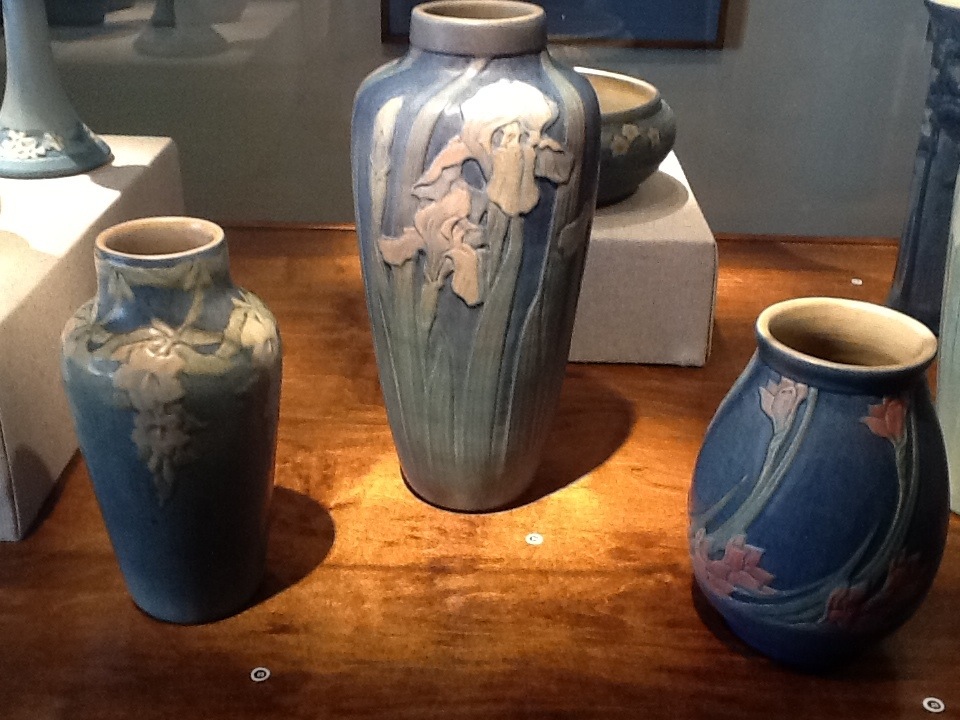
In any case Newcomb operated this pottery business for about 50 years really, from the late 1800s through the early 1940s. Its pottery became quite the collectors item for arts and crafts pottery enthusiasts and it is some of the loveliest work you’ll see. The detail is striking, especially since they often used local flora and fauna for their motifs.
The arts and crafts movement itself was an artistic response to the industrialization of America and also a way to allow women to work on their degree. Having grown up also in Ohio, I was already familiar with Rookwood Pottery, which was the most well known of the arts and crafts pottery-a friend in Cincinnati has Rookwood fireplace detail in her apartment, which is not that unusual to find there….
The Newcomb school allowed women to design and paint designs, but the actual pottery wheel was handled by men! ugh. I’m gonna leave that alone….

Interestingly, the most well known prolific potter at Newcomb, Joseph Meyer, was the son of a French Market vendor who sold utilitarian wares.
This modest exhibit is at the perfect venue and is well worth the trip to Dumaine.

20121003-222815.jpg

20121003-222827.jpg

20121003-222843.jpg

20121003-222912.jpg

20121003-222919.jpg

20121003-222928.jpg

20121003-222936.jpg

20121003-222943.jpg

20121003-222955.jpg

20121003-223004.jpg

20121003-223010.jpg

20121003-223018.jpg

20121003-223036.jpg

<;a

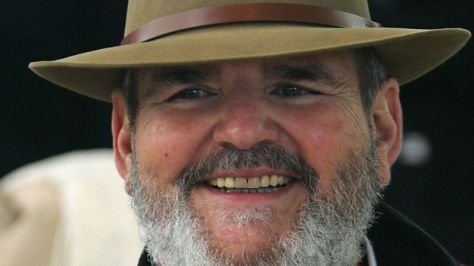
RIP Paul Prudhomme

I met him in the mid 1980s while I was working in the kitchen at the Royal Sonesta. He was gracious to our entire staff and even made our evil sous chef behave. What he did for New Orleans, for Louisiana and for talented chefs who want to create their own place and use their own ideas is incalculable; I remember well the daily excitement and long lines at KPauls for so many years. The love pouring out from the restaurant community around town shows the deep respect the entire community had for him and I’m sure that admiration is multiplied around the state.

Oral history

Source: Paul Prudhomme, the internationally-known superstar Louisiana chef and restaurateur, has died after a brief illness.

I wish I wish: Two opinions on Maple Street Bookstore’s closing

After reading the writer’s opinion/apology in the Advocate about losing Maple Street, I decided to add my opinion here. You can read his in the link that is at the bottom of this post. Here are my thoughts:

I loved the Maple Street store. In the 1980s, I traveled by streetcar up to it regularly from my downtown teen life. That store, along with Little Professor on Carrollton, DeVille’s on Carondelet (although frightening to find yourself the focus of George’s eye while there, as mocking might ensue), Doubleday and other chains on Canal and all of the used bookstores in the Quarter were my delights. In the Quarter, my favorites were Beckham’s for its quiet and its history section, Librairie’s well-organized criticism and anthology section, Matt’s biography section and Olive Tree (?) on Royal for the overall quality of books available. I remember the constant consternation of my best friend Roger Simonson about what he thought was the disgraceful amount of money I spent on the books that lined the walls of my tiny efficiency on Burgundy. He disapproved, but when I decided to move back to Ohio sometime later, he gamely helped me load and unload the 22 huge boxes of books I couldn’t bear to part with at the Amtrak station to ship them there the cheapest way.

But back to those browsing days Uptown: I would open the screen door at Maple and slowly make my way back through the rooms and sit with a pile of books somewhere, listening to the wisps of conversation that made it to where I was sitting. I remember being entirely happy sitting there, choosing what to buy that day and making a list of the others, silently promising to come back for them as if I were leading a rescue team. The store was full of pictures of authors sitting exactly where I was sitting and  were clearly pictures of friends and not just a laundry list of who’s who.
Yet, when I moved back to New Orleans in 2000, I was delighted to find Octavia Books and for many reasons, it became my bookstore rather than returning regularly to Maple Street again. Some of those reasons may have something to do with the announcement of Maple Street closing so I’ll share them here.

In my estimation all great bookstores do a few things. Here are what I believe they do, in no particular order and in no means meant to be a comprehensive list. Just mine.
•They go deep in a few areas. No “human-scaled” bookstore can do everything, and local stores should reflect the tastes of those who work in it and buy for it. If there is someone who appreciates children’s literature, the store should reflect that deep interest by carrying the best of and the unique and be able to handsell it. Which also means that they have an organizational and shelving system to go that deep.
•The stores are beautiful, peaceful and have great light.
•The staff is welcoming and chatty, but people-wise enough to know when to stop talking and just nod to you in passing.
•They offer new and used books.
•They do events that are varied and interesting and held often enough to remind their shoppers to check their calendar but not too often to lose the regular quiet found in a good bookstore.
•They get to know their best customers tastes and alert those customers about what has arrived.
•They value local authors and distributors and support them with prime space.
•They involve themselves in the activities of their town or their street, offering space or support whenever possible.
•They stay attuned to changing needs and trends, adapting themselves to those when necessary and not in opposition to their own values.
•Their location is accessible to many kinds of travelers and have hours that reflect the needs of their area.
•Browsers get the same courtesies that buyers receive.

By those measures, Octavia became my go-to store post 2000. They don’t do all of these things, but my experienced eye told me they hit most of them well. Maple Street, on the other hand, had fewer of these qualities but remained my cherished store upon my return since it had been my first own bookstore. I did make sure to frequent it faithfully, that is, until the expansion happened. I was excited when Maple Street expanded to Bayou St. John (although a bit taken aback at the choice of location) but dismayed when the other new location at The Healing Center also opened simultaneously. I went to both and found those locations lacking in most of the above, and really seemed more like airport kiosks than bookstores and not at all like the original Maple Street. And when I returned to the original, the shelves had less and the store seemed…small for the first time.

I have also added other stores to my new favorite Octavia, such as Crescent City Books on Chartres, (and had added Beth’s Books in the Marigny while it lasted) and appreciate Blue Cypress’ neat layout and constantly evolving inventory. CCB has become my favorite for many of the reasons listed above including that I only need to walk a few blocks to get to it, but also because of booksellers like Michael Zell, who interestingly, I first met while he worked at Octavia a dozen years ago. The list of booksellers at Octavia that I knew and know by name and have talked with on many subjects is so extensive I couldn’t list it here, but what’s important is that the list continues to be added to regularly over these 15 years.
Here is why: the main thing that great bookstores do is to employ and encourage book people to build a community. In all local businesses, this is the goal certainly, but it is vital in bookstores since much of the inventory is the same as the others, and that inventory requires some information in order to be purchased. Reviews and prior awareness of the author do help, but truly, the ability of a great bookseller to handsell the right item is the key to success, even if that only means  stocking and “front facing” the best books to get the most views.
If I read every new book put out by Rebecca Solnit (which I do), then I can buy it anywhere. However, if one store’s staff calls out to me when I walk in, “Did you know Solnit has a new book out? It’s right there…” they are gonna get my business.
I don’t mean that every person should be known by face and list, but many should and the rest should be treated as if they are going to be on that list someday. And everyone who enters with the interest in finding a book or just wanting to be among books should feel welcome.

These type of store requires constant calibration in order to maintain the right scale, to find ways to create peaks of excitement and to increase levels of engagement with many tiers of customers. Unfortunately, Maple Street lost much of that intensive tinkering time with their expansion. And like many stores, they had already been hard hit by the online book-buying spike. The staff remained pleasant and chatty, but over time, seemed less familiar and less involved with the book community. The store was no longer bursting with book energy and authors coming and going but seemed increasingly forlorn on an embattled street of changing shops and harried students and construction. That sent a signal to those who desired a full experience or, put in other terms, the lack of or the loss of a winning personality is quite often a death blow to a local store. It’s unfortunate that the retail world now is so regularly changing that a few bad seasons can undo a beloved store, but it can and does often. Remember that as customers.
The good news is that bookselling still remains in local hands around town, and will as long as enough of us take the time on a hot Tuesday evening or a rainy Saturday to come by and buy something every once in a while, which in turn means that those inside have to be ready for whenever that time comes.

So, the final word is I will always miss Maple Street, but the truth is I was already missing it.

Source: Dennis Persica: I wish I would have gone to the Maple Street Bookshop more, now that it is closing | Opinion | The New Orleans Advocate — New Orleans, Louisiana

In New Orleans’ French Quarter, a cockatoo named Iko holds court 

Since my mom lives around the corner (and Fahy’s is a few doors down!) I have visited with Iko many times over the years. I stood next to BB during a parade at the corner a few years back and found her to be the consummate French Quarter resident: chatty, interested in the world and quirky, as it should be.

Behind the centuries-old bricks and shutters of the French Quarter are many lives that passersby cannot see. Any glimpse into a shadowy courtyard is a teaser. But there is one resident on Burgundy Street who beckons the outside world to take a longer look.