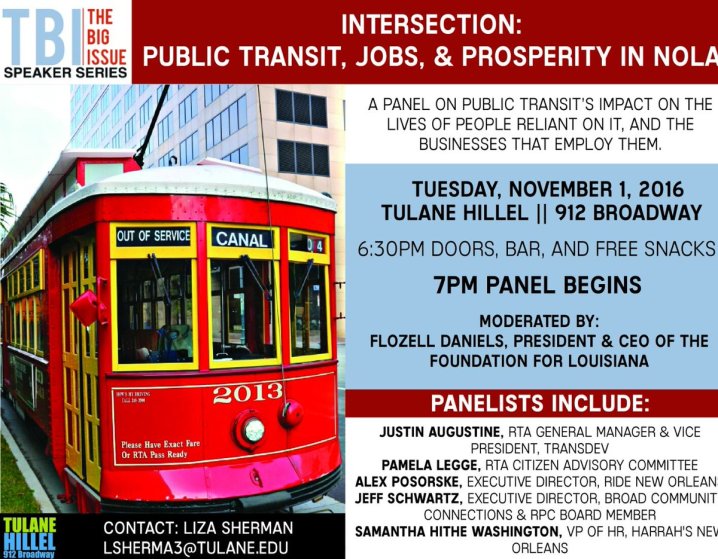
Public transit panel November 1

This year, one of our most popular ex-Saints football players was shot and killed on the busy streets of the busy Lower Garden District in the hours after one of our most attended public festivals. The story was initially reported as being that the shooter, Hayes, had followed him and shot him in an unprovoked attack. Hayes was reportedly carrying a gun legally and has said that he had it to his side pointed down until provoked by the victim. He says Smith went back to his car, got a gun and threatened him, although that gun has not surfaced. Smith’s wife was shot in both legs which certainly hurts Hayes’ story of only defending himself against a gun.
Hayes’ criminal record was immediately displayed as evidence of his lawlessness, even though it really told us nothing. The odd fact that the couple shot had just had dinner with the police officer who had shot Hayes’ father years earlier was used as evidence as vendetta by the media but for locals, it was just another version of the one or two degrees of separation and randomness that was super normal pre-K and is still expected.
Really, the tragedy is the argument that led to this was likely over nothing and only shows the lack of maturity on both sides. The ending paragraph of the GQ story tells it all in a nutshell: Hayes had no idea who it was he shot and, having been a promising player once himself, was horrified to find out the man he shot had been one of his favorite football players.
Generations of men grow up here and other places with bright dreams that are slowly squashed by reality and then one day, another man brushes too close to his girl or taps his prized car without apology. That speeds up the damaged heart and the rage stored there is quickly pumped throughout the body, leading to the moment when a gun is pointed and the trigger pulled. Maybe the hope is mostly that the gun itself will serve as enough of a warning to stop any other action (a MAN standing his ground), but the truth is too often that is not the end of it, but the tragic beginning.
The misguided and escalating anger over slight damage to personal property along with the fear among high-strung men (esp. an ex football player once arrested for a domestic violence charge against his wife after an altercation in public) of being “played” in public seem to be the real story here. Neither should be the reason for a death or trial and likely punishment of another. But here it is again.
I’ve known Earl and Pam since around the time that they began at the World’s Fair. My mother and her second husband (and then my brother when he moved here) were daily attendees of the Deja Vu when they owned it and we all spent time at the Decatur Gator in the 1980s too. I still pop in to catch some local musicians at the little TI on Bourbon every once in a while, and the Grapevine is quite a good place to get a glass of wine and to experience (read smell and taste) the bacon happy hour.
I also know folks who live very close to the flagship bar at Orleans and Bourbon who told me that TI is a very good neighbor to have which is a huge compliment in the Quarter from any resident.
Pam and Earl are a classic example of one type of entrepreneur that the French Quarter attracts. It is not the millennial hipster we get here but the savvy seasoned business person who can handle the chaos and the demands of operating in the Quarter. (I wrote about that a little in a post I did comparing the Quarter to the Cincinnati neighborhood of Over-The-Rhine. )
As for their real claim to fame, I recently remarked to friends that the Grenade has clearly outpaced the Hurricane as the favorite drink for tourists, based on the number of them that I see in the hands of sweaty, drunken visitors. Maybe it’s time for a craft artist to create a sculpture out of the glasses- maybe a life-sized gator to mark its prominence?
Pam is constantly roaming the Quarter and always up for a chat so keep an eye out for her and say hello.
Our best French Quarter museum, The Historic New Orleans Collection, has another interesting exhibit that just opened and will run for 6 months over on Royal Street. Their exhibits are free and are conveniently located just off the gift shop. The exhibit is called Goods of Every Description: Shopping in New Orleans, 1825–1925.
So much of what we ate, wore and used in this colonial city was imported from other American cities and in the case of the furniture or finer household items, quite often from European makers. One of the luxuries of being a significant port city.
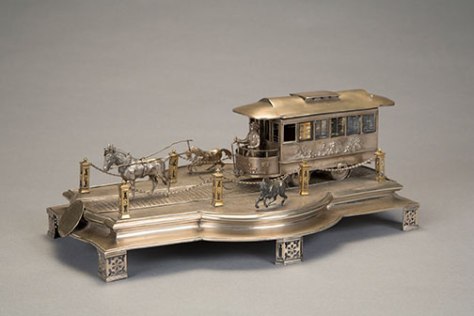
Mule-drawn streetcar model; between 1865 and 1870; silver, gold; by Zimmerman’s (New Orleans); The Historic New Orleans Collection, acquisition made possible by the Laussat Society, 2015.0464.20
My name is John Calhoun, and I am working with over a dozen Social Aid and Pleasure Clubs and the Orleans Public Defenders Office to plan a Second Line For Equal Justice to raise awareness about the crisis our public defenders office is facing and to encourage our city and state governments to adequately fund indigent defense.
Source: GoFundMe
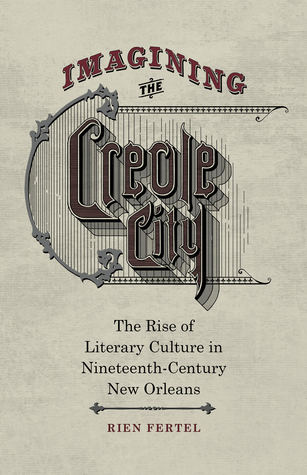
One relevant reason for this book is the recently reignited protests centering on race inequities and immigration across America, a conversation that is always sadly necessary in the American South. Local historian Rien Fertel addresses it by writing about the elite Creole literary circle that, starting in the 1820s/1830s, largely created and sustained the story of the region’s “exceptionalism.” That era of virtuous manifest destiny – not just in the South of course- is largely to blame for the lack of understanding among those who continue to grow up amid their own ethnic myths in the U.S.
For New Orleans, most people know the story of Creole culture only through Creoles of color who continue to inhabit the city, partly because they are largely responsible for much of what we continue to value culturally in New Orleans such as live music, public and family culture, and informal Carnival activities. But it is also convincingly identified here as resulting from the profiled writers unapologetic and sometimes incorrect assertion of their whiteness and its embedded privileges during Reconstruction through the turn of the 20th century. Yet the historical details contained here give those actions context and perspective; Fertel’s description of the politics of post-Louisiana Purchase New Orleans and the concern from the White House on any potential allegiance to the Old World as partially responsible for the Creoles’ sensitivity about the eclipse of their history is especially informative.
By offering individual profiles of prominent writers of Creole history starting with eminent historian Charles Gayarré, “Transcendentalist” New Orleans Choctaw missionary Adrien Rouquette and through those writers who took up the “cause” in the 20th century, including Grace King, Robert Tallant and Lyle Saxon, Fertel offers a human-scaled trek through that complicated history and time. Having the book end with the profile of George Washington Cable and his more inclusive history of the city, he shows the reordering of history that began with Cable as well as the tension among writers, which (partly) led to Cable’s self-imposed exile from the city. Fertel does his best to fairly catalogue both good and bad (or the long and the short) of that tension; for example, he shares how Grace King’s later-in-life acknowledgement of Cable’s value to the city showed the potential for change among those earlier devoted only to the “gallant” Creole story.
The details gathered by many of these writers will continue to offer us a rich tapestry of Louisiana life and cannot be entirely eclipsed by their love of heroic epics or even their insistence on racial “purity” and entitlement that belied the truth that existed in the tumultuous and complicated times of Jim Crow’s America. Yet, the dismissal of most of these writers works in the last 50 years as provincial cheerleading with either a stated or unstated allegiance to the “Lost Cause” should be a lesson in these Tea Party days and is vitally important for any writer in these times to consider.
 French Quarter block by block
You must be logged in to post a comment.