History, people, fables and critical essays on the 24/7 life of the French Quarter. “The great music of the city is…when you say good morning and good evening.” (Mr. Jerome Smith)
Listen to The Anthology of Louisiana Literature‘s 2-part interview with Dr. Nancy Dixon, editor of one of the necessary books for any New Orleans scholar or armchair historian: N.O. Lit: 200 Years of New Orleans Literature. Even if this brilliant woman wasn’t my pal, I’d still be urging you to get a copy. I open it up again and again to read her selections from different authors.
The 560 pages includes a well-curated set of short fiction and plays that reflect the city’s literary history, from Paul Louis LeBlanc de Villeneuve’s 18th-century play The Festival of the Young Corn, or The Heroism of Poucha-Houmma to Fatima Shaik’s 1987 short story “Climbing Monkey Hill.”
Dixon provides informative introductions to each author’s section, placing the works and their creators within the context of the city’s history and the history of its literature, making the anthology both an enjoyable artful artifact and an important academic resource.
The story around this battle is one of the better U.S. examples of reframing history to create a more valiant narrative (see the lyrics to the 1950s Johnny Horton song below).It is true that Jackson did decimate the British troops present on that battleground, but it is also true that that the the treaty had been signed by this point, although not yet ratified by Congress; that happened a little over a month later. Of course protracted battles even after treaties were not an uncommon occurrence in the days before communication advances like the telegraph could let field troops know what was going on. And this battle – no matter its significance to the war of 1812 – proved how important the port of New Orleans has always been to the world.
The reenactment crowd has a great time with this day and many New Orleanians go down to Chalmette to view the battle. Current historians consider the battle a stalemate, but at the time it was seen as a glorious day for Andrew Jackson and led to his prominence and later election as President. Unfortunately, he may have been one of the most autocratic Presidents of all time and in terms of his treatment of native Americans and of enslaved Americans, he deserves much scorn. He did found the Democratic party, although it’s resemblance to its present platform is slight; in his time, it was the party of slaveholders and state’s rights and helped to create the conditions that led to the Civil War. It wasn’t the party of big government and champion to the downtrodden until the 20th century beginning with William Jennings Bryan’s strategy to draw the Western states to the party, and finally culminating in FDR’s New Deal in the 1930s.
In December 1814, as diplomats met in Europe to hammer out a truce in the War of 1812, British forces mobilized for what they hoped would be the campaign’s finishing blow. After defeating Napoleon in Europe earlier that year, Great Britain had redoubled its efforts against its former colonies and launched a three-pronged invasion of the United States. American forces had managed to check two of the incursions at the Battles of Baltimore and Plattsburgh, but now the British planned to invade New Orleans—a vital seaport considered the gateway to the United States’ newly purchased territory in the West. If it could seize the Crescent City, the British Empire would gain dominion over the Mississippi River and hold the trade of the entire American South under its thumb….
…The two sides first came to blows on December 23, when Jackson launched a daring nighttime attack on British forces bivouacked nine miles south of New Orleans. Jackson then fell back to Rodriguez Canal, a ten-foot-wide millrace located near Chalmette Plantation off the Mississippi River. Using local slave labor, he widened the canal into a defensive trench and used the excess dirt to build a seven-foot-tall earthen rampart buttressed with timber. When complete, this “Line Jackson” stretched nearly a mile from the east bank of the Mississippi to a nearly impassable marsh. “Here we shall plant our stakes,” Jackson told his men, “and not abandon them until we drive these red-coat rascals into the river, or the swamp.”
Pakenham put his plan to action at daybreak on January 8.
…The assault on Jackson’s fortifications was a fiasco, costing the British some 2,000 casualties including three generals and seven colonels—all of it in the span of only 30 minutes. Amazingly, Jackson’s ragtag outfit had lost less than 100 men.
…When Congress ratified the agreement on February 16, 1815, the War of 1812 came to an official end. The conflict is now considered to have concluded in a stalemate, but at the time, the victory at New Orleans had elevated national pride to such a level that many Americans chalked it up as a win.
In 1814 we took a little trip
Along with Colonel Jackson down the mighty Mississippi
We took a little bacon and we took a little beans
And we caught the bloody British in the town of New Orleans
We fired our guns and the British kept a-comin’
There wasn’t nigh as many as there was a while ago
We fired once more and they began to runnin’
On down the Mississippi to the Gulf of Mexico
We looked down the river and we seed the British come
And there must have been a hundred of ’em beatin’ on the drum
They stepped so high and they made their bugles ring
We stood behind our cotton bales and didn’t say a thing
We fired our guns and the British kept a-comin’
There wasn’t nigh as many as there was a while ago
We fired once more and they began to runnin’
On down the Mississippi to the Gulf of Mexico
Old Hickory said we could take ’em by surprise
If we didn’t fire our muskets ’till we looked ’em in the eyes
We held our fire ’till we seed their faces well
Then we opened up our squirrel guns and gave ’em
Well, we
Fired our guns and the British kept a-comin’
There wasn’t nigh as many as there was a while ago
We fired once more and they began to runnin’
On down the Mississippi to the Gulf of Mexico
Yeah they ran through the briers and they ran through the brambles
And they ran through the bushes where a rabbit couldn’t go
They ran so fast that the hounds couldn’t catch ’em
On down the Mississippi to the Gulf of Mexico
We fired our cannon ’till the barrel melted down
So we grabbed an alligator and we fought another round
We filled his head with cannonballs ‘n’ powdered his behind
And when we touched the powder off, the gator lost his mind
We fired our guns and the British kept a-comin’
There wasn’t nigh as many as there was a while ago
We fired once more and they began to runnin’
On down the Mississippi to the Gulf of Mexico
Yeah they ran through the briers and they ran through the brambles
And they ran through the bushes where a rabbit couldn’t go
They ran so fast that the hounds couldn’t catch ’em
On down the Mississippi to the Gulf of Mexico
Hut, hut, three, four
Sound off, three, four
Hut, hut, three, four
Sound off, three, four
Hut, hut, three, four
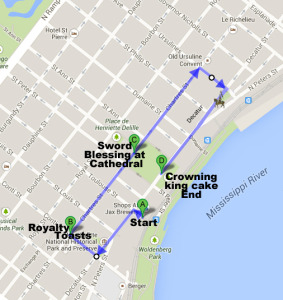
Revelers will find an artistic, whimsical and convivial Francophone parade winding through it. The Joan of Arc parade rolls at 7 p.m., and as is tradition, the 9th anniversary edition of the parade will stay true to its custom of celebrating the French saint who led her fellow countrymen in relieving the siege at Orleans, France, in the Hundred Years War.
Symbolism is imbued in every aspect of the parade’s planning. So, too, with its new highlights.
Among the additions in 2017 will be small stuffed ponies distributed by members who will ride newly-crafted horse tricycles or stick ponies escorting a new confetti cannon.
“It’s a handmade, authentic cannon, and that’s not something you hear everyday,” said Krewe de Jeanne d’Arc founder Amy Kirk Duvoisin. “That was made by one of our krewe-members, and … it shoots confetti — blue, white and red confetti — so throughout the parade route, we’re going to stop and shoot off the cannon. In the way we do things, it’s not random. It’s actually an homage to this cannoneer who fought with Joan in the siege of Orleans.”
WEATHER UPDATE! The @SugarBowlNola New Year’s Eve Parade will now start at 1:30 p.m. due to the forecasted weather
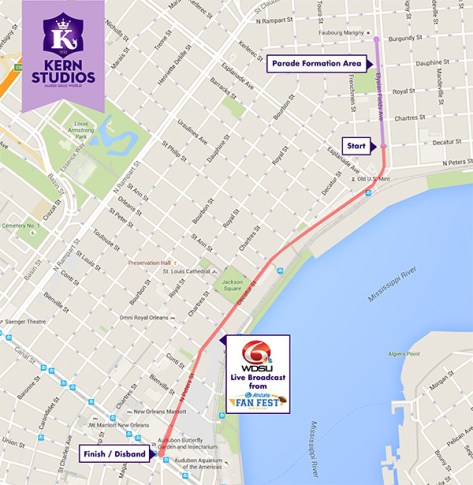
The parade begins at the intersection of Elysian Fields Avenue and Decatur Street at 1:30 p.m. CT (NOTE: UPDATED START TIME!).
At approximately 2 p.m., the Parade will pass the WDSU stage at the Allstate Fan Fest on Decatur Street inside the Jax Brewery parking lot, where WDSU has set up for live coverage of the parade – all performers will do a two-minute show at this location. The parade wraps up on Canal Street.
Writer Rebecca Solnit calls Christmas Day one of the 3 Punitive Holidays, the other being Thanksgiving and Valentine’s Day. Certainly seems like the Western world overdoes these with the result that those without formal traditions feel punished.
I am one of those without traditions by choice, even though I have access if I so desired. I could show up for gift-giving or a special meal at my non-traditional mother’s place but like many of us in the FQ, her home is for quiet time and so her holidays are calm and simple. My sister’s life is firmly in the Midwest where she has a fluid set of her own traditions with her friends and her son. And even though many wonderful friends invite me over to their own ramped-up holiday activities, for the most part I decline. It’s not that I don’t like to eat great food or to see people in a celebratory mood; it’s just that I like those made into everyday, informal activities.
I like regular days and organizing my days around drama-free activities and tasks, keeping my day open for impromptu meet ups with friends and acquaintances. Having coffee with pals in late morning or a cocktail and appetizers at the bar of a nearby restaurant or hotel in midweek is what I think is special. It’s why I like markets and not festivals: markets are a public and regular part of a week’s activities while most festivals are outsized events celebrating some cultural touchpoint that often requires hours away from home which often has a negative impact on regular commerce and far too often an extra fee for participation.
The only holiday I really celebrate is Carnival because the main activity (for locals) is to meet up and hang out with your friends and neighbors. In fact, the entire Carnival season, through customs built by families and neighborhoods, allows you to join in when and how it is convenient to your routine. Even the actual holiday of Fat Tuesday is mostly about roving, casual conviviality although, as befits the last day of a long season, it does have added costumes and a large amount of mood accelerants thrown in to pump it up a bit.
Most importantly, Mardi Gras has not (yet) been entirely taken over by the retail sector even though many attempts to scale that wall have been made. It is true that New Orleans’ Carnival has some deep, oligarchic tendencies – some of those hidden from view while others on full display without any irony or shame – but at its heart, Carnival is about regular people in public spaces employing satire and performance to comment and view others’ feelings on political power, class divides and cultural ties. That’s my kind of special time.
I think it’s high time we reduced the emphasis on Hallmark Holidays and use our creativity to instead create more everyday get-togethers. If people resisted the pull of these formal set-asides, more people would then start their day with anticipation upon remembering that it’s Saturday morning again. Or would take a long weekend off as a family to sit around and make a special meal together. Or send cards randomly to exclaim Happy Winter Day or to share your best hopes for a Bright Autumn. The third Tuesday of the month could become a simple gift exchange for your crowd or extended family. Use one’s gift-buying impulse to get some gloves or socks and share with those who are outside regularly. Use the kitchen time to prepare some treats or plates of food and share with those without. Marathon showings of movies on the shortest day of the year could still happen on those channels that seem to specialize in those. Close the stores early every 21st day. Wrap your homes in lights to celebrate the nearby high-school spirit. Have a block party on election day. Or just be in silence and quiet reflecting on the specialness of the world around us.
In these ways. we can use those warm feelings that we seem to only reserve for our fellow man on certain holidays, year round instead.
(Further solidifying my theory that the river end of Canal will soon have a majority of high end retail shops and visitor amenities, with lower-end retail migrating closer to the hospital corridor on Canal and on Tulane. Now, if only the city would step up and offer the owners incentives for rent-controlled apartments and “boarding houses” on the top floors of some of these buildings to keep premium staff for these places and for the restaurant industry nearby. This would revitalize Canal and Iberville overnight.)
The buildings will also include a gift shop and Sazerac company offices, with a projection of 60 employees eventually working there, 45 of which will be new positions.
The buildings, which have sat vacant for more than 30 years, date back to the mid-1800s and contain rich architectural details including wood floors, high ceilings, over-sized windows, and ornate support columns throughout. As many of the original design elements as possible will be kept as the buildings undergo renovation.
Sadly, only one in the French Quarter. Everything else on the other side of Canal, although all are in the “Sliver by the River.”
I would agree with most of these choices except for Clancy’s. I think Anderson tries hard to convince us in his review that it isn’t the old (read stale) New Orleans place that we used to have too many, all about the “see-and-be-seen” vibe that it really is about and not about great food or great service. It has been my experience – and the same for many friends – that if you are not known to the staff as a regular, you would not like it. Or if you think that fresher ingredients and lighter dishes are rightfully known as the new New Orleans menu, then you surely won’t agree with it being chosen. Instead, I’d put Aaron Burgau’s Patois or Alex Harrell’s Angeline* downtown in its place.
*Well well; soon after he was skipped by nola.com, Harrell was chosen as NOLa Chef of the year on Thrillist.
 French Quarter block by block
You must be logged in to post a comment.