The link at the end of this post will send you to one of the best pieces I have read on the maturation of an activist. For me, this essay by New Orleans activist-writer John Clark is up there with Michael Harrington’s autobiography and Roxanne Dunbar-Ortiz’s memoir of her participation in the 1960s-1970s social movements, which includes her time spent around New Orleans. I’ll also add Diana di Prima’s second memoir, Recollections of My Life as a Woman and Sonia Johnson’s story of her excommunication from the Mormon Church for her feminist activism in From Housewife to Heretic.
John Clark is a legend among those of us organizing around direct action, liberation, and social ecology – and not just here in Louisiana. As a matter of fact, it was his name that made my acquaintance with the great Peter Berg and Judy Goldhaft in San Francisco in 2006. I had gone out there with a few Louisiana fishing families to gain them some new long term buyers of their products while our state was still in shock and its people mostly still evacuated. While out there, I contacted a few names in movement work working on place and equity, including Peter and Judy’s Planet Drum Foundation. Berg’s name was already known to me for his guerilla theater (a term he coined in l963) work in the 60s through his amazing Diggers and before that, with the San Francisco Mime Troupe, but I knew nothing of his Planet Drum efforts until I read about it in one of Gary Snyder’s books. Once I investigated their site, it seemed a great fit for recalibrating my own post-disaster framework and so I sought them out. They immediately answered my email and invited me for lunch in the Mission District, taking me on a tour of community places, and then to lunch where they gave me gifts of wooden utensils and an envelope of Peter’s poems.
The pair asked after Clark, who I had only met once or twice, but of course, knew from events around town and through our shared workplace, Loyola University. That Clark connection led me into a deep conversation with Peter and Judy over a few hours where they listened to me describe the conditions we were facing in New Orleans. Peter finally said to me, “Well, it seems to me you just need to keep agitating, keep eyes on it, keep being there. Shout about it, cry about it but be there.”
The truth was, I was thinking about possibly bolting from New Orleans for a short time to recover my own equilibrium and peace. Their conversation and the reminder of Clark et al being back home doing revelatory work rekindled my desire to stay in New Orleans, in my little FEMA trailer on the bayou.
Additionally, John’s writings have helped me define my own world ethic and opened the door to knowledge a little wider, connecting me to writers that I would not have found on my own. As an autodidact, I rely on the informal and relational to find my education and so I was surprised as anyone to find a university professor as one of my wells of knowledge.
This piece is a reflection of his time agitating, shouting, crying and being there around the American Alligator region of Turtle Island.
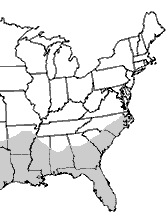
A visual of the American Alligator region
Perhaps the most decisive turning point in the transformation of my perspective on radical change occurred in 2005, when I experienced the trauma of Hurricane Katrina, the devastation of much of New Orleans in the flooding, and the corporate capitalist and structurally racist re-engineering of the city in the post-Katrina period. I learned the most important lessons from participation in Post-Katrina grassroots recovery communities. I learned to appreciate more deeply the meaning of crisis and collapse. I learned about the role of trauma in personal and group transformation. I learned that another good criterion for assessing groups is the extent to which at crucial moments they put aside everything that is merely habitual and inessential and respond whole-heartedly to the greatest and most vital needs.
… I decided a few years ago that it was necessary to leave the university where I taught for decades, and to start working more directly, full-time, for the process of social and ecological regeneration. I started a project called La Terre Institute for Community and Ecology, situated on what has now grown to 87 acres at Bayou La Terre, in addition to having programs in New Orleans, to help pursue this work. I have learned from the early stages of the project that it is urgently necessary to find a small community of similarly motivated people who can work together, in order to make this undertaking a success.
I have become preoccupied with the question of how, given the actual conditions in the world, we can break with, and then overcome, the capitalist, statist, patriarchal system of domination, and prevent global collapse, while at the same time creating a free, just, and caring society. I have learned that it is necessary to focus carefully on the question: “What is the decisive step?” or perhaps more accurately, “What is the decisive process?” A few years ago, in a book called The Impossible Community, a work that was very much a product of the Post-Katrina experience, I argued for the need to address at once all the primary spheres of social determination. These include the social institutional structure, the social ideology, the social imaginary, and the social ethos. I concluded that to achieve this goal the most urgent necessity is the creation of small communities of liberation and solidarity, of awakening and care.
PM Press – Lessons from the School of Radical Change: Notes of a Slow Learner
https://loyno.academia.edu/JohnClark
 French Quarter block by block
You must be logged in to post a comment.