Bourbon Street residents (and homes within a block of it too) must be allowed to go to a special quiet part of heaven when they die…
Once again, the French Quarter leads the way, as noise is an issue everywhere. Th idea of mixed-use neighborhoods is great, but how do you balance the needs between business owners and residents in a 24 hour a day area?
Also, some of those other streets house some shops that blare the music out over the sidewalk til all hours, so the city’s finger should not just point at loud music from clubs and bars…
What is also true is the lack of full-time residents mean that there are fewer people to organize. Many part-time residents don’t care about the long-term quality of life issues, only if the party continues when they visit 1-2 times a season…
wdsu
Tag Archives: French Quarter
Grand Duchess floats back to town
The last time I heard from the GD was during the French Quarter Festival, when her neighbor delivered a message to me from an alert Duchess, who spied me from her balcony. That post
As I know that the Duchess locks up her house for the summer and takes long trips east and west (“never South or North my dear; there’s been entirely too much traffic in THOSE directions over the years”), I was surprised when I noticed the curtains blowing out from her 3rd story. I rang the bell and was admitted warmly by her live-in, Miss Maude who looked fresh as a daisy in the 96 degrees, as all true New Orleans ladies do.
I knew to wait for the Duchess in the cool, darkish middle room on the second floor, which is where she receives guests in the summer. I sat in the large wicker chair after making myself a lemon ginger drink from the tall pitcher, mixed together with ice from the bar freezer and mint from her glorious garden.
garden description
I could hear the muted chatter from nearby streets and feel the fans churning above me. The second floor seems cooled by old-fashioned architecture and strategic breezes rather than too-large air conditioning machines (as the Duchess calls them).
I sat relaxing and cooling and opened my eyes when I smelled verbena. The Duchess had entered and was shooing one of the fattest of her cats to the next room. Soon after, she sat in her usual straight-backed chair across from me.
“I am surprised to see you home in the summer, Duchess”
We believe that in moments of high drama, our citizens need us to be alert.
“I assume you are referring to the historic river levels?”
We are referring to the Mississippi and Atchafalaya river levels, yes. It is our wish that no one suffers on behalf of the village’s residents, but unfortunately, this time some will suffer to save the old city. We hope that our cousins in the Louisiana provinces know that our gratitude and empathy rises to them at this time
“Do you believe the levees will hold?”
We have personally inspected the levee in our village and believe it is safe. However, I cannot vouchsafe for the other villages surrounding ours and hope their royal servants are taking their citizens safety seriously.
“Duchess, I do not believe the other neighborhoods have a Duke or Duchess such as yourself that watch over them.”
(She looked at me sharply as if to gauge my seriousness and then shook her head sorrowfully)
If that is true, our concern is profound for those places. We hope that someday they can restore a personage to serve their needs.
In any case, we must all remember that water is both our saviour and our curse. We cannot control the mighty rivers forever, so must live in such a way as to not draw their ire and still prepare for the days that the water will change its course. We have been thinking a great deal on this subject and offer these decrees:
All villagers must teach each other basic swimming techniques.
All villagers should keep a flotation device available.
The staff of Loyola Avenue must ask for widow’s walks or wrapping galleries to be built on all new buildings above one story.
Second and third floor windows must have an exit path.
Those villagers with means should store expandable ladders of 15 feet or more on second floors or in attics. Rope ladders are more useful but must be inspected regularly for strength. (DW-I mentioned the usefulness and long life of nylon rope, an idea which pleased the Duchess and she begged me to insert the word nylon to the decree above.)
All villagers should make the acquaintance of at least one neighbor who seems to be alone and then to be responsible for that person in times of environmental or federal crisis.
After her decrees were stated, she rose, bade me to follow her into her library and showed me a brass bell and a beautiful old oar from a small boat. She told me they had been given to her by a grateful river pilot many years ago. As she went to ask Maude to show me out, I noticed an first English edition of Mark Twain’s “Life on the Mississippi” near the items and surreptitiously opened it to find this confounding inscription:
To the gracious lady downriver who watches over us all. Mark Twain
To read the original post explaining our Duchess:
Duchess
Doctor’s Offer To Save Le Petit Turned Down – New Orleans News Story – WDSU New Orleans
Oh we live on the water by the way
In case you forget that the reason for the city to exist is for access to the mightiest of our hemisphere’s rivers, Big Muddy will remind us later this month.
The water should crest less than a few feet from the top of the French Quarter’s/Uptown’s levees in about 2 weeks. This is a map that shows where the water will go when they open the Morganza Spillway . Both spillways (Bonnet Carre opened today) are opened to relieve pressure on our levees and will result in loss of farmland and fish this year with the intrusion of fresh water into the brackish water.

1850 house
Our Yesteryear councilwoman Jackie Clarkson calls the French Quarter “our front porch” and as much as I hate to agree with her, I do sometimes find it impossible to counter everything she says. That statement I agreed with (it is a miracle, but it is still possible we mean it in very different ways. That is how I comfort myself.)
So to continue the marketing, the front porch of the front porch is Jackson Square. What remains amazing about the Square is even with all of the rules and regs that go along with good preservation, “new” still shows up there every once in a while. New art appears on the fence (I didn’t say it was all good art), young musicians show up to replace those now recording and appearing elsewhere and trust me- a new hustle is coming sooner or later from those unwashed over there.
In many ways, Jackson Square is the most modern of places. So, when you walk in a door and head upstairs to see the 1850 House, you might enjoy the juxtaposition.
It’s one of 3 museums on the square and certainly the most invisible one. Found in the middle of the Lower Pontalba block, you pay your small fee and are quite courteously shown the stairs to go up and reminded to take pictures and left alone to do that (well except for the cameras keeping track on every floor).
The stairwell pictured is theirs. I took the picture, because it is certainly a typical stair for the French Quarter, but probably not for any other citizen of the city. Unevenly worn treads and the smooth bannister tells you this has seen some folks.
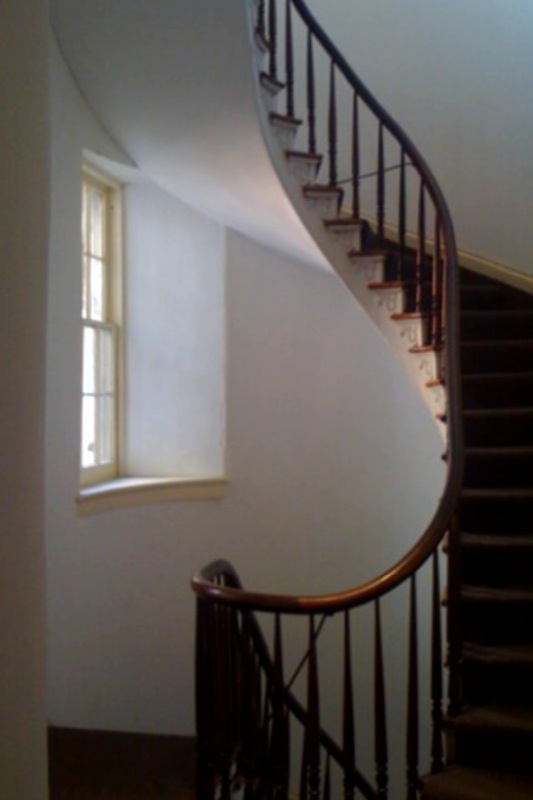
1850 House Pontalba
What is amusing is the central air vents strewn carelessly around the room and the mechanics to manage the system groaning between the “gentleman’s bedroom” and the large back bedroom; Also amusing are the odd little placards explaining what you are looking at:; for the most part, certainly dated with very basic information. What is very nice are the stories of the first tenants of the building: I learned a great deal about the type of resident these apartments attracted and their businesses in New Orleans (first) heyday. I wish someone would find out what happened after mid 1860s in these rooms, but maybe if we start to climb those stairs more regularly and ask, they’ll tell us more.
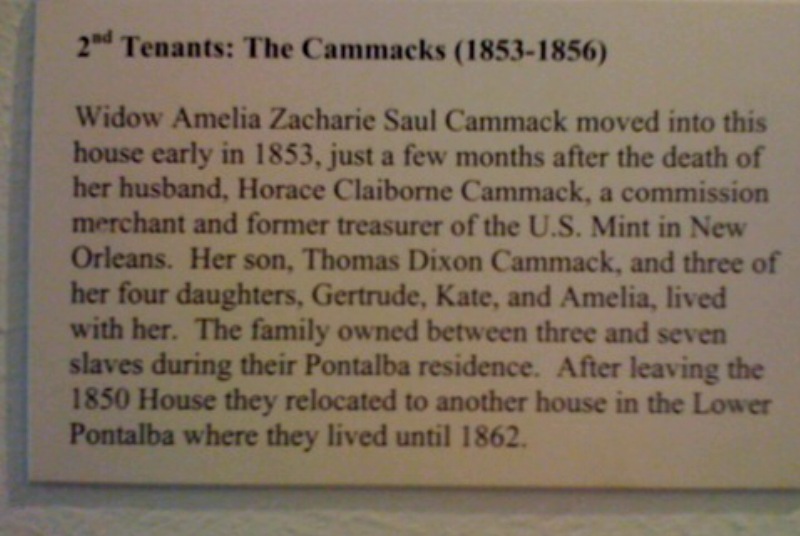
The Cammacks-1853-1856
I liked the back stairs the best with the view of the courtyard. I stood back there for a few minutes, enjoying the sounds from the square but really feeling the lack of activity in this house (really not a house at all anymore). For now the lights go off at 5:30 pm and the door is shut. No families, no mourning, no dinner at the table. Just history.
I wonder who was the last person to live in this building and when. One of those immigrants when it became a “slum” (as alluded to in the language) could tell us a thing or two about life in the 20th century. Any museums for that? I might enjoy a walk through that time too.
525 Madison-Gallery Circle Theater
A celebrated address for sale. Home of community theater and the start of Diane Ladd’s career.
I had heard about this theater over the years and back in the early 80s lived down the block. I would sit on my balcony and imagine theater goers arriving at dusk on foot and by taxi. Later as I stood inside my living room leaning against the doorway, I would think I could hear applause over the wall. Or maybe it was real and from around the corner in the Square, back in those days of jugglers and guitar players quietly practicing in front of stragglers late into the late night.
Gallery Circle Theater was the up-and-coming challenger to Le Petit. After two seasons – 1948-1950 – in the Jewish Community Center, GCT played the 1950-1951 season in the American Legion Hall. In September 1951, it opened its fourth season with Bob Cahlman directing Marion Schexnaydre [Zinser] in The Heiress in a new home at 525 Madison Street in the French Quarter. In 1953, Cahlman cast a young inexperienced newcomer from Mississippi, named Diane Ladner in Room Service. She would go on to become Diane Ladd, wife of Bruce Dern and mother of Laura Dern.
And this from the 2014 news story about it being for sale still (or again):
It was the 1950s when the Gallery Circle Theatre made a home here. Actress Diane Ladd got her start in the 1953 production called “The Heiress.” Caldeira said the property was larger and was cut in half about 20 years ago. “A gentleman who lived in the Quarter acquired this half of it and created this house,” said Caldeira.
It also held WPA gallery showings:
nutrias
 for sale in 2011 for 3 point 6 million bones, and in 2014 for 2 point 8. What a place.
Movies, 3
The Historic New Orleans Collection presents three screenings in conjunction with the exhibition Drawn to Life: Al Hirschfeld and the Theater of Tennessee Williams.
Sunday, March 13, 2 p.m.
The Line King: The Al Hirschfeld Story
An Academy Award-nominated documentary by Susan Warms Dryfoos, The Line King celebrates Hirschfeld’s many years of work for the New York Times, where his drawings were a centerpiece of the Sunday Arts section. With appearances by Lauren Bacall, Robert Goulet, and many others, The Line King is a fascinating portrait of the artist as a cultural icon. (1996; 86 minutes; not rated)
The exhibition will be open 12:30–4:30 p.m.
Sunday, March 20, 2 p.m.
The Fugitive Kind
Sidney Lumet’s stirring drama The Fugitive Kind (based on Tennessee Williams’s play Orpheus Descending) features Marlon Brando as a drifter who wanders into a small town in Mississippi and falls into a tragic love affair. Following the screening, Mark Cave, curator of manuscripts/oral historian at The Collection and co-curator of Drawn to Life, will discuss the film and the display. (1960; 120 minutes; not rated)
The exhibition will be open 12:30–4:30 p.m.
Tuesday, March 22, 6:30 p.m.
Journalist and anchor Eric Paulsen’s 1981 interview with Tennessee Williams
Noted news anchor Eric Paulsen conducted the final in-depth broadcast interview with Tennessee Williams in 1981, roughly two years before the playwright’s death. After the screening, Paulsen will discuss the interview and take questions from the audience. (1981; 47 minutes; not rated)
The exhibition will be open 9:30 a.m.–8 p.m.
 French Quarter block by block

You must be logged in to post a comment.