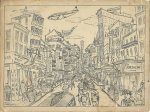
1883 Prohibiting any vehicle to drive at a faster gait than a walk in passing in front of French Market from Ursuline to St. Ann Streets during market hours.
1882 Prohibiting any piroge, lugger, flat boat or other small craft from selling produce from Esplanade Avenue to St. Ann Street without paying $1.00 per day.
1884 Forbidding the keeping for sale any fruit, fish, vegetables or fowls in any close building occupied in the past as a dwelling.
1891 Prohibiting the establishment of private markets without the permission of the Council.
1900 Regulating the governing of private markets, etc. Prohibiting the sale of oysters in public markets, and meat and vegetables in stores within 3200 ft.
1906 Regulating the sale of shrimps and crabs in the markets of the city after certain hours.
1934 Accepting the bid of the French Market Corporation for the privilege of operating the French Market and the lease-hold of French Market properties.
1936 Prohibiting the sale of intoxicating liquors within close proximity of the Farmers’ Market at French Market.
1936 Designating the type of refrigeration to be installed in the various units of the French Market.
Markets
1937 Providing rules and regulations governing the operation of the new Farmers’ Market at French Market.
Verti Marte brethren
So, as we wait for one of our standbys to reopen in the French Quarter after the fire that took out Verti Marte last month, do see some of the others that have food and characters meanwhile:
Matassa’s (St. Philip and Dauphine). Louis and Johnny are usually hanging out in front while in back (watch that bump by the dairy counter) they’re cooking up solid meals. Beans, chicken, catfish and much more.
Quartermaster, better known as the Nelly Deli (Ursuline and Bourbon)- their sides are tasty; burgers, lasagna too. I think their breakfast is really great to take over to the Moonwalk with a Cafe au Lait from CdM on your way.
St. Peter St. (between Royal and Bourbon) has some stuff too now with Yo Mama’s famous burgers there and a rejuvenated Rouse’s Supermarket (I laugh when I hear complaints about higher prices for the food there- we’re talking less than 30 cents usually, if at all and they have brought more fresh foods, some local and a much cleaner store to the very small population of the FQ. Work with them and make it better by asking for items you don’t see and comparing prices).
Some items at the store at St. Philip and Royal can be good (red beans are usually excellent) but look closely as their food dries out under those lights.
Felipe’s on Decatur is a cheap good meal, especially when you get there during happy hour for your drinks.
Deja Vu’s food counter can be an incredible deal; spaghetti is usually very good.
Basically, all of these have to go menus that give you at least 2 meals worth of food for under 10 bucks.
Cafe Amelie
Grabbing some wifi at CC’s on St. Philip just now, I ran into the chef from Cafe Amelie, Jerry Mixon who was picking up some caffeine to start his and Danny’s day at the restaurant. This restaurant is a jewel in the middle of the French Quarter and the history of the Princess of Monaco courtyard (that it sits in) is fascinating. This was Prince Albert’s wife (the one from the 1880s, not the son of Grace Kelly). The Princess of Monaco was born as Alice Heine at 910 Royal; her family was instrumental in the cast iron balcony business. Cast iron was fashionable throughout the US in the 1840s and 1850s, but in New Orleans has remained so. Richard Campanella (social scientist, author of New Orleans Then and Now, Bienville’s Dilemma among others) has done research on cast iron work and theorizes that there was a bit of “Keeping up with the Jones” attitude in why you see more elaborate iron work, the closer you get to Jackson Square/wealthier homes.
Heinrich Heine, the well known, highly respected German-Jewish romantic poet & philosopher, was her great uncle. Like Baroness Pontalba, she did not enjoy married life and left the restrictive royal family life she married into and moved to Paris where she entertained artists and such at her salon in Paris. Her family tried to get part of her 6,000,000 dowry back from the Grimaldis but were unable. easy come easy go, I guess. Or maybe freedom is really just a word for nothin’ left to lose.
The hexagon tower seen from the front was commissioned by renowned architect Henry Howard. The courtyard is fabulous for sitting and eating Jerry’s wonderful gumbo with a cocktail in the evenings.
Royal Street- 1950s
Books, haunted corridor and corsets- all in one block
800 Chartres-
As you walk through the carnival that is Jackson Square (going away from Canal Street) you almost immediately enter a hushed and cool block. The side of Pontalba Apartments is interesting, and some of the balconies are lovely and actually used by real people.
Check out the beautiful downspouts at 830 Chartres; copper with the covered iron work at the person level with its open mouth at the street. Incredible.
This block of Chartres that is split by lovely little Madison Street is one of my favorites. Partly because I lived on Madison back in the wild 80s and sat on my balcony nursing any number of hangovers while looking at Chartres. Possibly also because one of my favorite bookstores is there- Librairie is one of the older used bookstores still in existence (my memory is that it opened in 84 or so) , and I think I found my prized copy of Anita Loos’ Cast of Thousands and all of my Cornelia Otis Skinner books there. Part of a weird collection I had.
It’s the neatest (meaning things are shelved) of all of them and I believe is run by Beckham’s Books owner, the other great bookstore in the Quarter that goes back a long ways. That one (Beckham’s) is the best on a rainy Saturday.
I also like the mix of facades and the little shops like Trashy Diva. Perfect for the Quarter. Both Divas and Spicy and Dark, and Ragin Daisy’s second place that is opening soon in that block (I still miss that Chinese laundry) and a couple of others lovely clothing stores that I of course don’t shop at, but are pretty cool to have all there in a row. Think of it as Girlie Way.
The corner of Dumaine and Chartres has the oldest set of intact row houses and was the site of the Conde Market in 1782. The wooden toy shop needs their display windows cleaned but is a very cool place to take kids or bored husbands by the looks of it.
The haunted part of the title comes from Muriel’s Restaurant’s corridor and second floor. Supposed to be haunted.
<a href="
A Better Mousetrap
If you were ambling down Royal Street back in the early 1970s, you probably went into a store that was owned by Roger Simonson on Royal Street. Closed around 1974, A Better Mousetrap sold posters, cards, and any hot new item of the time.. Roger was raised in Peoria, moved to New Orleans in the 1960s (following his older brother to the area) where he went to UNO and happily found his forever home. Roger went on to own other businesses after ABM, but spent most of his remaining years as a high-end kitchenware salesman and then as a cab driver. His uniform was usually jeans and a button-down shirt with a snappy tie during the day (and short shorts and clogs in the summer!), a leather-booted lighter peeking from his pocket and after 5 pm, beer or a gin and tonic in his hand (cheap gin was always the choice). Roger was seen throughout the 80s and 90s at The Steak Pit, Sloppy Jim’s Bar (much more on that place sooner or later), Rawhide, and Mama Rosa’a among other Quarter places. Some may also remember him during his time running the Persian Boy Gallery on Decatur in the 1990s, until PB owner Roger Bogle’s murder shut all of his businesses down.
A Better Mousetrap didn’t last long, but it foretold the trend to fun kitsch/card shops in the Quarter. Roger was one of two longtime Quarter characters that came from ABM: Sooner or later, you’ll meet the other in an interview here with ABM employee Sam, who continues to work in the French Quarter.
Yeah you rite!
A sampling of the many neighborhood and class-based accents in New Orleans circa 1983 from the documentary YEAH YOU RITE! by Louis Alvarez and Andrew Kolker.
LOUIS ALVAREZ and ANDREW KOLKER, twice winners of both the Peabody Award and the duPont-Columbia Journalism Award, have over the past 25 years produced critically praised documentaries on American culture, treating important topics in American life with a unique mixture of humor and poignancy. In addition to People Like Us, Alvarez and Kolker have tackled motherhood (MOMS), politics (Vote for Me and Louisiana Boys — Raised on Politics), accents (American Tongues), sexuality (Sex: female), and the globalization of pop culture (The Japanese Version). Kolker and Alvarez began their careers in New Orleans and now live in New York City.
New Orleans accents


You must be logged in to post a comment.