Deal of the Day on Groupon

If you are not familiar with Groupon, I encourage you to sign up to receive the deal of the day email. Based on a group of people accepting the deal, you can get up to 75% off very good products and services. It’s a great way to find out about things going on around town, like this groupon today.
$15 for Two Tickets to the Louisiana State Museum’s Winter Art & Antiques Show. Choose from Two Dates.

Most people have no idea there is an antiques show in the French Quarter. Just when everyone thinks you can only get great deals on daquiris and sunglasses, this news comes along just in time.

check out:
http://www.winterartandantiques.com

and the Groupon site itself:
http://www.groupon.com/new-orleans/

Grand Duchess talks about graffiti

Tags on historic buildings are often quite shocking. The effort that is takes to rid some of it is expensive or even damaging to the surface, especially when lunatic fringe vigilantes take it upon themselves to spray industrial strength paint across the tag, often larger or messier than the original work. Of course, the difference between tags and graffiti should be understood, although I understand to some it is one and the same.  Tagging does seem to be an issue once again in the French Quarter, and since I have been so successful lately in getting good quotes from the Grand Duchess of the Vieux Carre, I called on her again, with felt pen in hand this time.

Here are her surprising thoughts:

What is your take on the war against graffiti in the village?
We are against war.

Do you mean you AGREE with graffiti?
We do not agree with any idea every time.

Do you like graffiti?
We appreciate artistic expression, activist tendencies and personal responsibility.

Hmmm. (I pretended I understood, but realized this was a never-ending tangle. I decided to take another tack):
Have you seen “informal artistic activity” that you appreciated?
We will assume you are referring to the practice of painting an expression on a building that one does not currently hold title. We have.

Have you seen informal artistic activity that you disliked?
We have.

Do you have any decrees that would answer this quandary?
We believe that half of available advertising space (excluding our village’s stores and their signage) should be designated instead for informal expression. The Staff may ask that it is limited to what does not incite violence or frighten children beyond a reasonable amount expected in this harsh world. We would suggest they ask artists to do their best to illuminate the public conversation, and not demean it.
Any artist who is then caught using a non-designated area to express their view should expect to be treated as outcasts by the village’s citizens and be asked to provide a number of hours for non-artistic community service to clean up after these offenders.

Duchess, may I say this is a surprising and probably polarizing view-point. May I ask how you arrived at this viewpoint?
We explain thusly:We have many friends in many different careers. Some are archaeologists, some are historians, some are tradesmen. The tradesman we use for stonework recently explained to us that work on the Giza Plateau in far off Egypt recently uncovered the graffiti of the original work gangs scrawled across the upper most chambers, (chambers that were never meant to be entered, which may have only been included to relieve the tremendous weight upon the main chamber). This graffiti has been able to answer some of the most important questions our modern world has of its predecessors in the desert. These work gangs’ tags allowed the world to understand the craftsmen who were not slaves at all (contrary to many years of history lessons) and instead were paid workers. Yes, questions remain of the graffiti’s veracity, but we are refreshed by the notion of workmen spelling out their pride. We also understand that many steelworkers and painters and other skilled workers do this, and think is an excellent way to sign one’s work. Additionally, activity that tells of impending clashes can be understood earlier; artists can illuminate an issue in this manner.

Banksy in New Orleans post-Katrina

Banksy in New Orleans post-Katrina

Knowing we had reached the end of the interview, I stood, quietly capped my pen and thanked her for her time. As I opened the door, the Duchess handed me a lovely old book, murmuring that it was for me. When I made it to the street light at her corner, I saw it was a lengthy translation of graffiti found in ancient Pompeii.

I

Grand Duchess addresses trivial questions

For those who read this little blog from time to time, you will notice that I enjoy introducing you to the great many people who use the French Quarter for business or for a wide selection of diversions or those who call it their home.

One that I met many many years ago is the Grand Duchess of the Vieux Carre. I do not remember when I met her, only that my friend Roger Simonson knew her and had a deep admiration for her. He introduced us (quite formally as I remember now) one summer evening when we went to her building before going to dinner at The Steak Pit down the street. We were charmingly introduced to all of her beautiful cats (we were told that all were named after Roman generals or burlesque dancers) as she led us through her rooms showing us her incredible collection of 1920s erotica which seemed to include some self portraits. I saw her after that from time to time, but had not spoken to her since Roger’s untimely passing. When I returned to the area a decade or more ago, I received a note in the mail at my mother’s welcoming me back home. I have no idea how she knew.
With some questions about how things have been running around the Quarter, I recently tramped up the rickety wooden stairs to the Grand Duchess’ airy rooms to ask about her feelings on festivals in her village (as she is also known to call the Vieux Carre), and was granted the right to publish her “decrees” as she terms them. As it has been a great long time since her public had heard from her, many questions have arisen about her and her official status since the first post.
So, I once again trudged the circular, slightly dusty stairs to see if she felt it was important to attend to the public’s perception of her. She listened carefully to my thoughts on the subject and asked me to return to her door in a fortnight’s time.
After looking up fortnight up on my iPhone, I agreed.
We sat with paper and pen (she allowed me to use a ballpoint even though her views on them are well known) while I fired questions. She often drank from her creme de menthe slowly and gazed out the window with what seemed to be a great deal of interest. It turned out she did that only when she had decided not to answer a particular query. Took me a bit to figure that out, so this short interview took half a day and almost a full bottle.
What is your full title?
We are known as the Grand Duchess of the Vieux Carre. Not the “French Quarter”. We can be called Duchess informally.
What are your responsibilities?
We serve the people of the Vieux Carre as we see fit.
How long have you been Grand Duchess?
(Drinking, window gazing here. )
Will you be offering more guidance in the form of decrees?
What other form is there?
Do you think the French Quarter is managed well by the staff of Loyola Avenue? (DW: “The Staff or paid staff of Loyola Avenue” seems to be what she calls City Hall ) finally deciding after a great deal more drinking and gazing and long silence that she would not answer any question formed with “French Quarter” in the question, I rephrased:
Do you think the village is managed well by the staff of Loyola Avenue?
We do not think “being managed” as you term it (with a impish nod towards me) is in the best interest of my people. We do not worry about (or for) The Staff on Loyola Avenue, although we wish them good health and wisdom.
Will you meet with the Loyola staff?
The only meetings that matter are chance and clandestine ones.
How will they know what to do then?
If they commit to honoring all personal expressions (up until it negatively affects another) they will know what to do. If they employ clear thinking and direct communication with as many of my people as they can stand before making a decision on their behalf (and follow my directives) they will succeed.

As I had clearly been granted a great many answers without too many uncomfortable, lengthy pauses, I thanked her with a nod (or maybe it was even a bit of a bow). With that, I clicked close my ballpoint (earning a slight frown from the Duchess) and left her to the twilight and her many cats.

Verti Marte is coming along…

For those who miss their corner store on Royal, the signs are looking good that we will see them back before Mardi Gras passes.

and Santa says hi. but only to the Uptown side of town.

Royal (Orleans) valet mover

another ingenious use of space in the French Quarter. Parking valets at the Omni Royal (or for you old folks the Royal Orleans or for you old OLD folks, the Saint Louis) use this vertical people mover to get up to upper floors to get a car, or to come down after parking. No waiting for elevators (that would break more often) or dodging cars on the ramps.

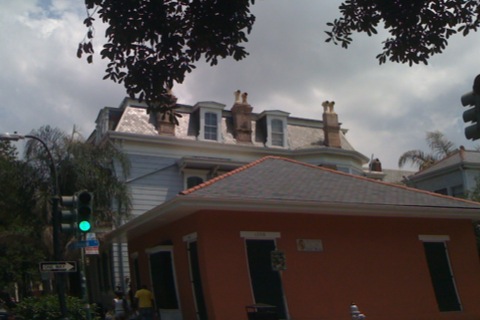
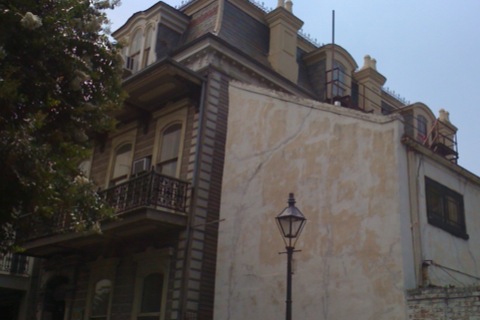
Mansard roofs/Second Empire style

These 2 are actually near to each other; 1 on Esplanade and 1 on first block from Esplanade. Same architect? Built in same era? So few of them in the French Quarter, it might actually be a story or link.

The style of mansard roofs is associated the Second French Empire (1852–1870) of Napoléon III, the nephew of Napoleon I. Elected President by popular vote in 1848, he initiated a coup d’état in 1851, becoming dictator before ascending the throne as Napoleon III on 2 December 1852, the forty-eighth anniversary of Napoleon I’s coronation. He ruled as Emperor of the French until 4 September 1870. Napoleon III envisioned a Grand Scheme for the Americas, which would consist of three general points. The first involved recognition of the Confederate States of America and a military alliance with them. The second involved reintroducing monarchical rule to Latin America, in the form of Maximillian I in Mexico, and increasing French trade throughout Latin America. The third point involved control over Mexico with the creation of a large buffer state from the Rio Grande to the Baja California peninsula. Among other things, the Emperor granted the right to strike to French workers in 1864, despite intense opposition from corporate lobbies
Two distinct traits of the mansard roof – steep sides and a double pitch – sometimes lead to it being confused with other roof types. Since the upper slope of a mansard roof is rarely visible from the ground, a conventional single-plane roof with steep sides are often misidentified as a mansard roof. The gambrel roof style, commonly seen in barns in North America, is a close cousin of the mansard. Both mansard and gambrel roofs fall under the general classification of “curb roofs” (a pitched roof that slopes away from the ridge in two successive planes).However, the mansard is a curb hip roof, with slopes on all sides of the building, and the gambrel is a curb gable roof, with slopes on only two sides. (The curb is a horizontal heavy timber directly under the intersection of the two roof surfaces.)

In France and Germany, no distinction is made between gambrels and mansards – they are both called “mansards”. In the French language, mansarde can be a term for the style of roof, or for the garret living space, or attic, directly within it.

So, THAT’S where the library went…

1853 Providing that Fisk Library, founded under the bequest of the late Abijah Fisk, together with a lot and building on the corner of Bourbon and Customhouse (now Iberville) Streets, be transferred and assigned to the Mechanics Society of New Orleans to be held and used by them for the same purposes and trusts under which now used. The said library to be preserved and enlarged and be known as the “Fisk Free Library”.
1881 Requesting the President of the Mechanics Society to turn over to the City the Fisk Free Library together with the lot and building on the corner of Bourbon and Customhouse (now Iberville) Streets, so that said property may be administered in accordance with the will of Abijah Fisk bearing date of Nov. 27, 1843. Also providing that the library be removed to the room in the City Hall Building known as the Public School City Library, and that the rental accruing from lot and building on Bourbon and Customhouse Streets be applied solely to the enlargement of the library.
1894 Providing that the Public Library shall be kept open daily for access of the public between the hours of 9 A.M. and 3 P.M., and from 6 P.M. to 10 P.M. Sundays and Holidays excepted.