Doctor’s Offer To Save Le Petit Turned Down – New Orleans News Story – WDSU New Orleans.
walk. click. walk, click, click.
Heard about an inventive name for a website-a pretty good one at that: Through The VieuxFinder is a creative effort with a yen for our city and time to help you discover it. They will take you out side by side with professional photographers and give you a walking history lesson while using your camera.
Make some time in your week, take the real camera out of the drawer, leave the smartPhone at home and go learn some tricks to shooting good photos.
Cheap drinks, bookstores, extra bathrooms
Oh we live on the water by the way
In case you forget that the reason for the city to exist is for access to the mightiest of our hemisphere’s rivers, Big Muddy will remind us later this month.
The water should crest less than a few feet from the top of the French Quarter’s/Uptown’s levees in about 2 weeks. This is a map that shows where the water will go when they open the Morganza Spillway . Both spillways (Bonnet Carre opened today) are opened to relieve pressure on our levees and will result in loss of farmland and fish this year with the intrusion of fresh water into the brackish water.

Beauregard Square? who knew?
Turns out the space that has been known since the 1800s as Congo Square is actually called Beauregard Square for a Confed general who also has a statue at the entrance of City Park and a house tour in the Quarter. Seems the name change in favor of the general came in 1893 which seems about right, knowing the revisionist history that went on in the South around that time and that it was the year of his death. From the T-P article: “According to widely accepted historical tradition, African-American slaves were allowed to gather on Sunday afternoons in an open field just outside the city, at a spot known by various names including Place Congo. The slaves and free people of color used this space to market goods, to socialize and to sing, make music and dance, maintaining their cultural heritage as well as social cohesion. White New Orleanians and visitors to the city would go there to witness African-American music and dance.”
Congo Square is within Louis Armstrong Park at the “end” of Saint Ann if you are leaving the Quarter. The park’s current condition is deplorable and maybe the name change for this most important history will spark some action for this public space to be a jewel rather than an locked up eyesore. (Can I suggest a tearing down of the fence to begin?)
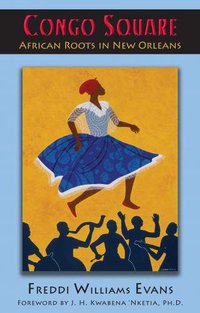
Author of “Congo Square: African Roots in New Orleans” Freddi Evans is appearing at Octavia Books and I am sure more signings to come to showcase her definitive history. I saw her speak at the TWLF this year and she is a delightful, gentle speaker with a firm grasp of her subject. Do yourself a favor and go hear her speak.
To order book
She will be at Octavia Tuesday at 6 pm.
 t
t
1850 house
Our Yesteryear councilwoman Jackie Clarkson calls the French Quarter “our front porch” and as much as I hate to agree with her, I do sometimes find it impossible to counter everything she says. That statement I agreed with (it is a miracle, but it is still possible we mean it in very different ways. That is how I comfort myself.)
So to continue the marketing, the front porch of the front porch is Jackson Square. What remains amazing about the Square is even with all of the rules and regs that go along with good preservation, “new” still shows up there every once in a while. New art appears on the fence (I didn’t say it was all good art), young musicians show up to replace those now recording and appearing elsewhere and trust me- a new hustle is coming sooner or later from those unwashed over there.
In many ways, Jackson Square is the most modern of places. So, when you walk in a door and head upstairs to see the 1850 House, you might enjoy the juxtaposition.
It’s one of 3 museums on the square and certainly the most invisible one. Found in the middle of the Lower Pontalba block, you pay your small fee and are quite courteously shown the stairs to go up and reminded to take pictures and left alone to do that (well except for the cameras keeping track on every floor).
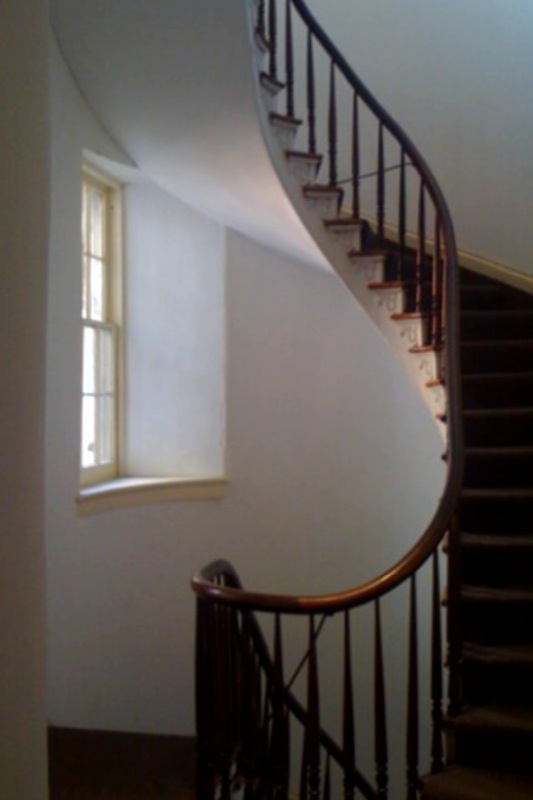
The stairwell pictured is theirs. I took the picture, because it is certainly a typical stair for the French Quarter, but probably not for any other citizen of the city. Unevenly worn treads and the smooth bannister tells you this has seen some folks.
1850 House Pontalba
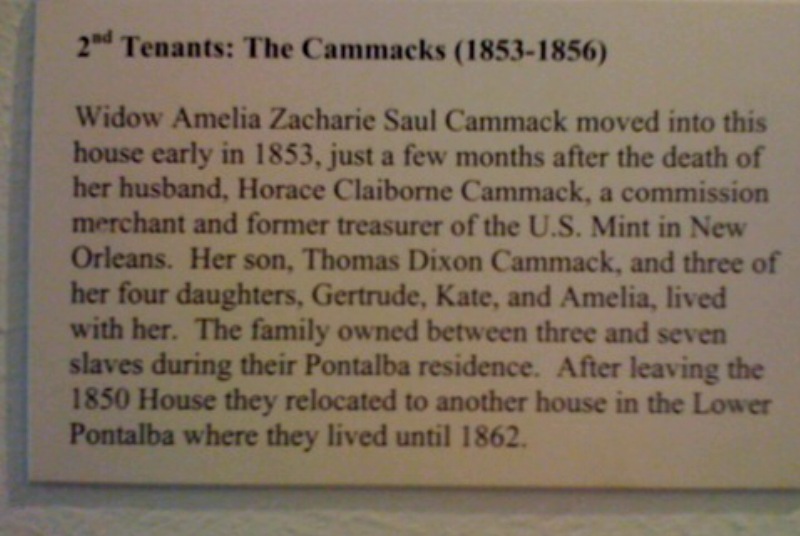
What is amusing is the central air vents strewn carelessly around the room and the mechanics to manage the system groaning between the “gentleman’s bedroom” and the large back bedroom; Also amusing are the odd little placards explaining what you are looking at:; for the most part, certainly dated with very basic information. What is very nice are the stories of the first tenants of the building: I learned a great deal about the type of resident these apartments attracted and their businesses in New Orleans (first) heyday. I wish someone would find out what happened after mid 1860s in these rooms, but maybe if we start to climb those stairs more regularly and ask, they’ll tell us more.
The Cammacks-1853-1856
I liked the back stairs the best with the view of the courtyard. I stood back there for a few minutes, enjoying the sounds from the square but really feeling the lack of activity in this house (really not a house at all anymore). For now the lights go off at 5:30 pm and the door is shut. No families, no mourning, no dinner at the table. Just history.
I wonder who was the last person to live in this building and when. One of those immigrants when it became a “slum” (as alluded to in the language) could tell us a thing or two about life in the 20th century. Any museums for that? I might enjoy a walk through that time too.
525 Madison-Gallery Circle Theater
A celebrated address for sale. Home of community theater and the start of Diane Ladd’s career.
I had heard about this theater over the years and back in the early 80s lived down the block. I would sit on my balcony and imagine theater goers arriving at dusk on foot and by taxi. Later as I stood inside my living room leaning against the doorway, I would think I could hear applause over the wall. Or maybe it was real and from around the corner in the Square, back in those days of jugglers and guitar players quietly practicing in front of stragglers late into the late night.
Gallery Circle Theater was the up-and-coming challenger to Le Petit. After two seasons – 1948-1950 – in the Jewish Community Center, GCT played the 1950-1951 season in the American Legion Hall. In September 1951, it opened its fourth season with Bob Cahlman directing Marion Schexnaydre [Zinser] in The Heiress in a new home at 525 Madison Street in the French Quarter. In 1953, Cahlman cast a young inexperienced newcomer from Mississippi, named Diane Ladner in Room Service. She would go on to become Diane Ladd, wife of Bruce Dern and mother of Laura Dern.
And this from the 2014 news story about it being for sale still (or again):
It was the 1950s when the Gallery Circle Theatre made a home here. Actress Diane Ladd got her start in the 1953 production called “The Heiress.” Caldeira said the property was larger and was cut in half about 20 years ago. “A gentleman who lived in the Quarter acquired this half of it and created this house,” said Caldeira.
It also held WPA gallery showings:
nutrias
 for sale in 2011 for 3 point 6 million bones, and in 2014 for 2 point 8. What a place.
 French Quarter block by block

You must be logged in to post a comment.