Grand Duchess talks about graffiti

Tags on historic buildings are often quite shocking. The effort that is takes to rid some of it is expensive or even damaging to the surface, especially when lunatic fringe vigilantes take it upon themselves to spray industrial strength paint across the tag, often larger or messier than the original work. Of course, the difference between tags and graffiti should be understood, although I understand to some it is one and the same.  Tagging does seem to be an issue once again in the French Quarter, and since I have been so successful lately in getting good quotes from the Grand Duchess of the Vieux Carre, I called on her again, with felt pen in hand this time.

Here are her surprising thoughts:

What is your take on the war against graffiti in the village?
We are against war.

Do you mean you AGREE with graffiti?
We do not agree with any idea every time.

Do you like graffiti?
We appreciate artistic expression, activist tendencies and personal responsibility.

Hmmm. (I pretended I understood, but realized this was a never-ending tangle. I decided to take another tack):
Have you seen “informal artistic activity” that you appreciated?
We will assume you are referring to the practice of painting an expression on a building that one does not currently hold title. We have.

Have you seen informal artistic activity that you disliked?
We have.

Do you have any decrees that would answer this quandary?
We believe that half of available advertising space (excluding our village’s stores and their signage) should be designated instead for informal expression. The Staff may ask that it is limited to what does not incite violence or frighten children beyond a reasonable amount expected in this harsh world. We would suggest they ask artists to do their best to illuminate the public conversation, and not demean it.
Any artist who is then caught using a non-designated area to express their view should expect to be treated as outcasts by the village’s citizens and be asked to provide a number of hours for non-artistic community service to clean up after these offenders.

Duchess, may I say this is a surprising and probably polarizing view-point. May I ask how you arrived at this viewpoint?
We explain thusly:We have many friends in many different careers. Some are archaeologists, some are historians, some are tradesmen. The tradesman we use for stonework recently explained to us that work on the Giza Plateau in far off Egypt recently uncovered the graffiti of the original work gangs scrawled across the upper most chambers, (chambers that were never meant to be entered, which may have only been included to relieve the tremendous weight upon the main chamber). This graffiti has been able to answer some of the most important questions our modern world has of its predecessors in the desert. These work gangs’ tags allowed the world to understand the craftsmen who were not slaves at all (contrary to many years of history lessons) and instead were paid workers. Yes, questions remain of the graffiti’s veracity, but we are refreshed by the notion of workmen spelling out their pride. We also understand that many steelworkers and painters and other skilled workers do this, and think is an excellent way to sign one’s work. Additionally, activity that tells of impending clashes can be understood earlier; artists can illuminate an issue in this manner.

Banksy in New Orleans post-Katrina

Banksy in New Orleans post-Katrina

Knowing we had reached the end of the interview, I stood, quietly capped my pen and thanked her for her time. As I opened the door, the Duchess handed me a lovely old book, murmuring that it was for me. When I made it to the street light at her corner, I saw it was a lengthy translation of graffiti found in ancient Pompeii.

I

Grand Duchess addresses trivial questions

For those who read this little blog from time to time, you will notice that I enjoy introducing you to the great many people who use the French Quarter for business or for a wide selection of diversions or those who call it their home.

One that I met many many years ago is the Grand Duchess of the Vieux Carre. I do not remember when I met her, only that my friend Roger Simonson knew her and had a deep admiration for her. He introduced us (quite formally as I remember now) one summer evening when we went to her building before going to dinner at The Steak Pit down the street. We were charmingly introduced to all of her beautiful cats (we were told that all were named after Roman generals or burlesque dancers) as she led us through her rooms showing us her incredible collection of 1920s erotica which seemed to include some self portraits. I saw her after that from time to time, but had not spoken to her since Roger’s untimely passing. When I returned to the area a decade or more ago, I received a note in the mail at my mother’s welcoming me back home. I have no idea how she knew.
With some questions about how things have been running around the Quarter, I recently tramped up the rickety wooden stairs to the Grand Duchess’ airy rooms to ask about her feelings on festivals in her village (as she is also known to call the Vieux Carre), and was granted the right to publish her “decrees” as she terms them. As it has been a great long time since her public had heard from her, many questions have arisen about her and her official status since the first post.
So, I once again trudged the circular, slightly dusty stairs to see if she felt it was important to attend to the public’s perception of her. She listened carefully to my thoughts on the subject and asked me to return to her door in a fortnight’s time.
After looking up fortnight up on my iPhone, I agreed.
We sat with paper and pen (she allowed me to use a ballpoint even though her views on them are well known) while I fired questions. She often drank from her creme de menthe slowly and gazed out the window with what seemed to be a great deal of interest. It turned out she did that only when she had decided not to answer a particular query. Took me a bit to figure that out, so this short interview took half a day and almost a full bottle.
What is your full title?
We are known as the Grand Duchess of the Vieux Carre. Not the “French Quarter”. We can be called Duchess informally.
What are your responsibilities?
We serve the people of the Vieux Carre as we see fit.
How long have you been Grand Duchess?
(Drinking, window gazing here. )
Will you be offering more guidance in the form of decrees?
What other form is there?
Do you think the French Quarter is managed well by the staff of Loyola Avenue? (DW: “The Staff or paid staff of Loyola Avenue” seems to be what she calls City Hall ) finally deciding after a great deal more drinking and gazing and long silence that she would not answer any question formed with “French Quarter” in the question, I rephrased:
Do you think the village is managed well by the staff of Loyola Avenue?
We do not think “being managed” as you term it (with a impish nod towards me) is in the best interest of my people. We do not worry about (or for) The Staff on Loyola Avenue, although we wish them good health and wisdom.
Will you meet with the Loyola staff?
The only meetings that matter are chance and clandestine ones.
How will they know what to do then?
If they commit to honoring all personal expressions (up until it negatively affects another) they will know what to do. If they employ clear thinking and direct communication with as many of my people as they can stand before making a decision on their behalf (and follow my directives) they will succeed.

As I had clearly been granted a great many answers without too many uncomfortable, lengthy pauses, I thanked her with a nod (or maybe it was even a bit of a bow). With that, I clicked close my ballpoint (earning a slight frown from the Duchess) and left her to the twilight and her many cats.
St. Louis good citizen

Good citizen June Wiley calls police at 5 am, suspect caught soon after. AND is looking fresh as a daisy a few hours after when reporters catch up to her. (she’s my mom so maybe I’m a bit biased)…
Seriously, this is why we need to get rents in line with real costs so regular people can live in the French Quarter. This block of St. Louis is made up of mostly full-time residents except for the large house that has been empty for over 20 years. They clean their street, keep lights working and remain the “eyes on the street”. That’s even with 2 tough bars on this corner and on the next.
And sure that owner of the large empty house pays property tax (well I guess he does), but I suspect his assessment has stayed low and since the owner does not use the building or rent it or add to the liveability of the street, it seems pretty nice of the renting neighbors to watch out for his property for him.

good citizen video

840 North Rampart-Rock n’ Roll history

The Rock and Roll Hall of Fame and Museum designated Cosimo Matassa’s J&M Recording Studio as a historic Rock and Roll Landmark, one of 11 nationwide.
A few J&M recordings, including Fats Domino’s single “The Fat Man,” Roy Brown’s “Good Rockin Tonight” and Little Richard’s “Tutti Frutti” have sometimes been called the first rock n’ roll record.
Now a launderette, you can still hear Fats Domino at the piano if you listen closely enough when the rinse cycle comes on..
Then stop by and see the Matassa boys at the family store at St. Phillip and Dauphine and get some red beans for later…
from Frank Etheridge’s 2006 (?) Gambit story:
Matassa then opened a studio in a larger space on the 500 block of Gov. Nicholls Street in a former cold storage space for avocados — “great sound there,” he says — and then later expanded further when he moved to the 700 block of Camp Street in a building that also housed offices for his Dover record distribution business as well as a studio. Matassa also had a plant in Jefferson Parish to manufacture the records.

“I was trying to be a factor on the national level,” Matassa explains of his expansion in the years leading up to the mid-’60s. “But every time I went to a bank for a loan, they’d throw me out. Unfortunately, people in New Orleans with money at the time were only interested in real estate deals or oil deals. That’s why Nashville made it with the music industry, because the city had a couple of sympathetic banks.”

Protest to restore a park

Beth Lovett, Quarter resident

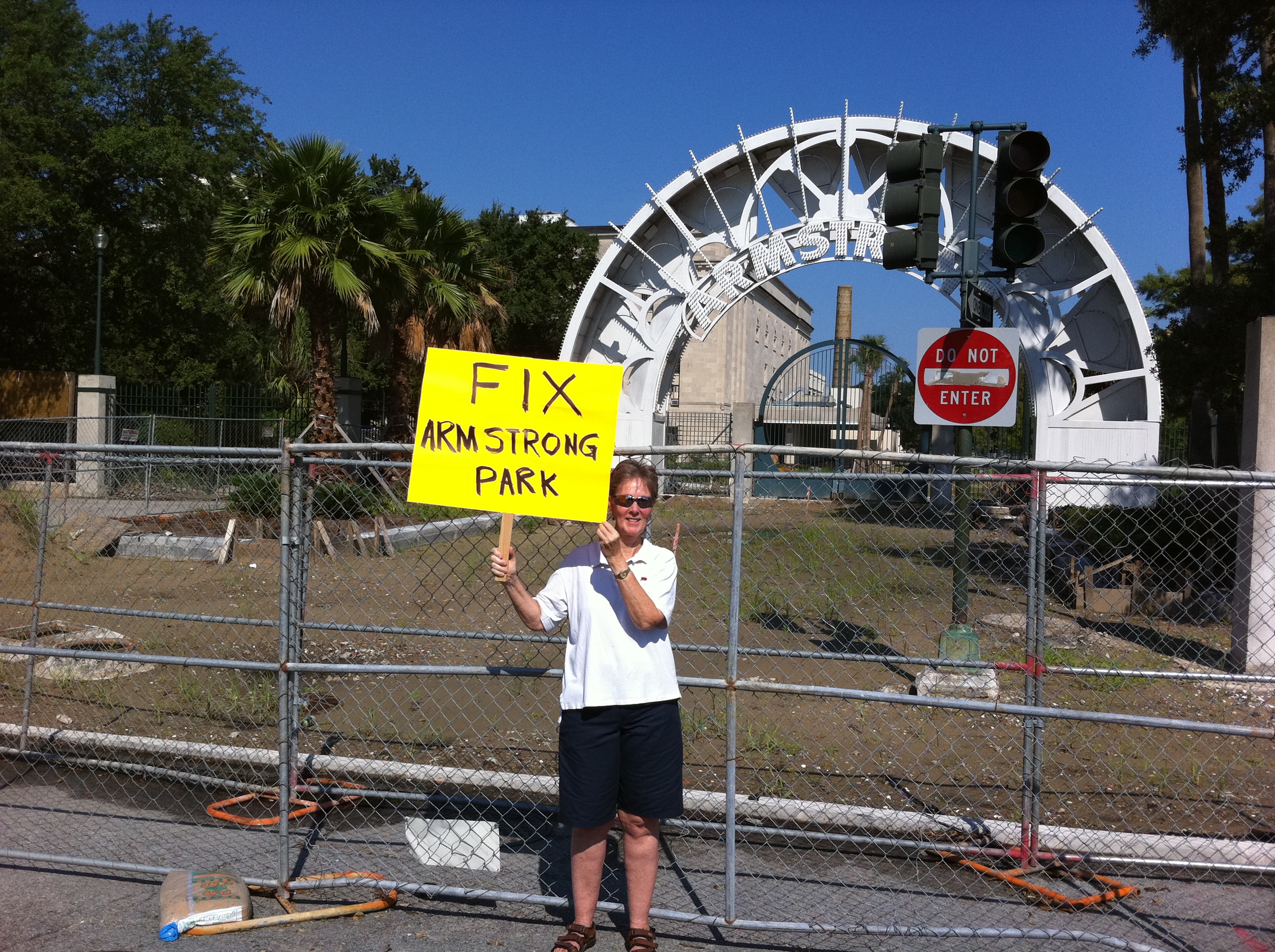
This morning French Quarter resident Beth Lovett protested in front of Armstrong Park about the park’s condition.

She also sent this email to all City Council members:

“Armstrong Park is a disgrace. Those of us who live in the neighborhood and

who use the green space on a daily basis are sickened by the deplorable

condition in which the City of New Orleans has left this treasured and

beautiful park. What is being done to insure that our park is finally being

restored?

This is not only a neighborhood issue. It is an embarrassment to our City.

Tourists ask why the park is not open. In the past I would tell them the

story of the “Nagin legacy”. Now it is your legacy.”

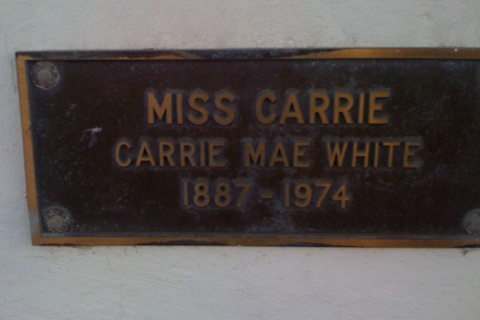
Miss Carrie Mae White 1887-1974

On the marble steps of 924 Orleans, see the plaque for Miss Carrie. There is a great description of her taken from the marvelous book 912 Orleans, The Story of a Rescue by Walter Lowry (illustrations by Mark Lowry), written about the 1960s renovation of the family home:
“The sun sets slowly. Its long red rays steam horizontally down the stillness of Orleans Street. Miss Carrie has brought out her folding chair and has taken her seat by her stoop to observe her domain. She insists she is 78 years old. Her physique denies this assertion, but her wisdom stoutly sustains it…Her friendship is very highly to be treasured.”

I miss the Miss Carries of the French Quarter….

Miss Carrie 924 Orleans Street

What did I see?

A few years ago, was sitting with a coworker at Coop’s on a Wednesday evening. We were at one of the tables to the side of the bar, and I was facing the door/window. Suddenly, I said “hey, there’s my friend K….” whom I had not seen in at least 6 months.
I excused myself, hurried outside but could not see him in the groups of people walking down Decatur, even though he was pretty tall.
I even looked down the side street but it seemed like he had disappeared.
Went back and mentioned it to my fellow diner and told her about him, and went on with our previous conversation. What I told her was that he was a great dinner companion, lively and a reputation for petty grift. Always had an angle/plan/situation, and his finances always seemed better than they should, based on where he worked. He never conned me; quite possibly like many of those types that are in New Orleans, he knew where and when to use those skills and where and when not to.
So the next weekend I went with my mom to the North Shore to tend to the family plot at the cemetery. While there, my cell phone rang. Mom was off getting water for my great grandmother’s grave, so I decided to answered it. (just so you know, grave tending is a normal family activity in New Orleans- that’s not the weird part).
“Hello. Is this D?”
“yes”
You don’t know me, but I am K’s _____ father. We have not heard from him in over 3 months and so am looking through his phone book. You’re the last name.” (W begins my last name)
I couldn’t believe it. I told him what had happened that week and tried to explain I was not a kook, making up stories. We talked for 10 minutes with my mother watching me curiously as she watered.
I asked him to call me back to tell me when he did hear from K…
I never got another call even though my number remains the same.
I think that I might have seen K….. because he wanted me to tell his father that he was okay. And so I guess I did my task.
This makes the second ghost I think I have seen.
Both of them in the French Quarter.