1850 house

Our Yesteryear councilwoman Jackie Clarkson calls the French Quarter “our front porch” and as much as I hate to agree with her, I do sometimes find it impossible to counter everything she says. That statement I agreed with (it is a miracle, but it is still possible we mean it in very different ways. That is how I comfort myself.)

So to continue the marketing, the front porch of the front porch is Jackson Square. What remains amazing about the Square is even with all of the rules and regs that go along with good preservation,  “new” still shows up there every once in a while. New art appears on the fence (I didn’t say it was all good art), young musicians show up to replace those now recording and appearing elsewhere and trust me- a new hustle is coming sooner or later from those unwashed over there.

In many ways, Jackson Square is the most modern of places. So, when you walk in a door and head upstairs to see the 1850 House, you might enjoy the juxtaposition.

It’s one of 3 museums on the square and certainly the most invisible one. Found in the middle of the Lower Pontalba block, you pay your small fee and are quite courteously shown the stairs to go up and reminded to take pictures and left alone to do that (well except for the cameras keeping track on every floor).

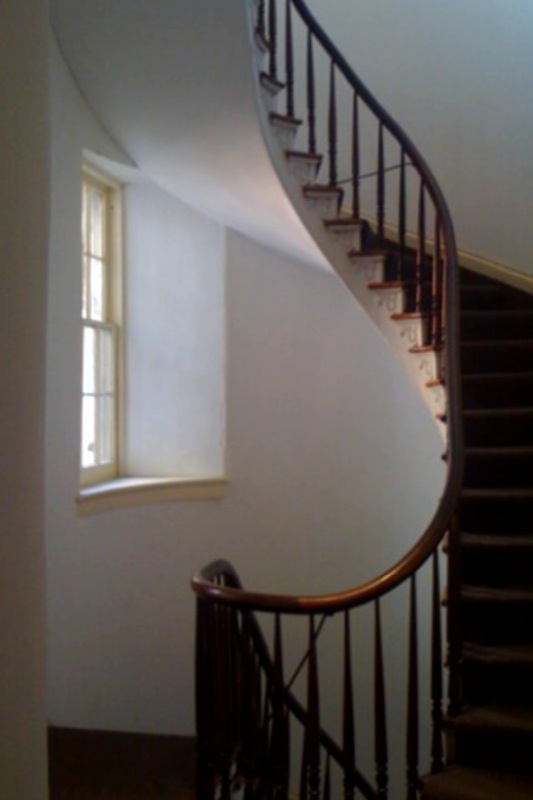
The stairwell pictured is theirs. I took the picture, because it is certainly a typical stair for the French Quarter, but probably not for any other citizen of the city. Unevenly worn treads and the smooth bannister tells you this has seen some folks.

1850 House Pontalba

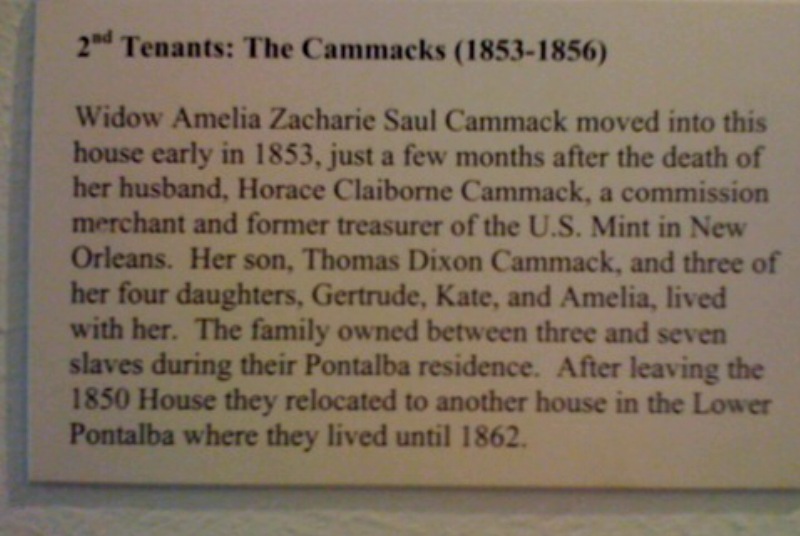
What is amusing is the central air vents strewn carelessly around the room and the mechanics to manage the system groaning between the “gentleman’s bedroom” and the large back bedroom; Also amusing are the odd little placards explaining what you are looking at:; for the most part, certainly dated with very basic information. What is very nice are the stories of the first tenants of the building: I learned a great deal about the type of resident these apartments attracted and their businesses in New Orleans (first) heyday. I wish someone would find out what happened after mid 1860s in these rooms, but maybe if we start to climb those stairs more regularly and ask, they’ll tell us more.

The Cammacks-1853-1856

I liked the back stairs the best with the view of the courtyard. I stood back there for a few minutes, enjoying the sounds from the square but really feeling the lack of activity in this house (really not a house at all anymore). For now the lights go off at 5:30 pm and the door is shut. No families, no mourning, no dinner at the table. Just history.

I wonder who was the last person to live in this building and when. One of those immigrants when it became a “slum” (as alluded to in the language) could tell us a thing or two about life in the 20th century. Any museums for that? I might enjoy a walk through that time too.

The story of Stanley and Stella

In restaurant form that is.
A classic New Orleans story with food as the central character. Scott Boswell, a young chef who is serious about his ongoing training, owns these restaurants with his wife Tanya. Scott is found at Stella’s working the kitchen (when he’s not traveling to restaurants to offer himself as a free apprentice) and Tanya can be seen daily at Stanley’s working the door and watching the entire place.
Both restaurants serve excellent food. Stella’s is award-winning and pretty expensive, but even with the deep pocket needed to go there,I can’t count how many times I have heard that this was the favorite meal of visitors and some locals who hit all of the top ones. Many times.
I know the chef and his wife from their stalwart support of the Crescent City Farmers Market, where I work. We opened a 4th location a few years before Katrina and they did anything they could do to support it. We’ll never forget it.
I like these folks because they are Quarter residents and real workers and committed to a scale of production, service and ambience that has made the city what it is.
(Now I have a friend who is not very happy with them and feels slighted in every way; she’s a savvy local who has loads of patience for quirks but got bad service and a worse response after, so I sorrowfully acknowledge that too. It’s the only version I have heard of that story, but she is pretty sore with them now.)
My experience has been great and now they have added a Stanley’s service bar right next door on the Square and so a tip of my cap again is in order. Espresso, pastries, ice cream and sandwiches in a beautifully designed storefront. Some work remains to do to get it all done but if you’re out at 8 am til evening in the area, go try the coffee or ice cream and then go have a eggs hollandaise poboy next door.

And revel in the culture renewing itself in the oldest part of the city, thanks to entrepreneurs like Scott and Tanya..

The newest addition to the Pontalba family. Espresso, pastries and ice cream from 8-7ish daily.

The Grand Duchess thinks about the Baroness

Over the last few weeks, there has been a back and forth about the Lower Pontalba rent prices. As many of you know, the Pontalba apartments are among the oldest in the country, having been built as apartments by Baroness Pontalba in the 1850s. As I have written before, you can see the inside of one by going to the 1850 museum in the middle of the lower block. It’s a self-guided tour with an apartment set up as it would have been in the 1850s (maybe they lived without the groaning a/c) and has some plaques explaining some of the family history of those who lived there then. The city manages the uptown side of things and this management falls under the French Market Corporation which has been having its own upheaval recently.
Rental prices are being debated for these treasures, since the councilwoman  has found out that they are rented well below the market rate for apts like that AND should be primary dwellings, which anyone who spends any time on the Square can tell you few are. Lights are generally on at most of them only a few days a year, and I assume you know which days I am referring. CM Palmer has also found out that they of course are rented to very prominent people at these lucky rates. However, in all likelihood, a few rents will increase but things will go on the same for most people there. The truth is that at market rate, few people who live in New Orleans full-time can afford it.
Although I would love to have stopped and sat on a particular sunny balcony to chat with the Grand Duchess to hear her views personally, I knew she was leaving for a hurried trip to the Middle East this very week. I instead left a message on her machine that I looked forward to talking with her on this subject when she returned. A suspicion that she enjoys my offer to publish her views was confirmed with the speed of her reply: within a day a call came from her live-in, Maude. Miss Maude told me the GD had sat down and written something as she was leaving and handed it to her, asking her to call me to read it. Miss Maude apologized before starting as her sight is not what it was and “with the intricate handwriting…”
but I suspect she just about got it word for word .
“So Miss Dar, here is what she says”:
Residing at the Pontalba is a privilege. 1/4 of these to be set aside for long-term employees of the stores below and/or those who work at Cafe DuMonde and should cost 1/4 of their monthly rate of pay.
She also says:
Those who get this privilege should have the good sense to have loads of parties and invite artists and dancers and musicians and serve excellent food and strong liquor and let the friendly noise drift over the Square… And to festoon their balconies with lovely crepe paper and greenery, changed every season of course. Also, as it should be remembered that crime is an issue in our village, one dweller should act as the block captain for 6 months at a time. This captain should walk through the Square weekly, noting any broken or missing valuables. They should chat with the eyes of the square (artists, musicians and sun seekers) discussing their concerns as well.
P.S. And all should remember to take a strong cup of coffee outside every morning and drink it gratefully with a silent nod to our dear Baroness. Our own Micaela who always chose gaiety over decorum and would do it again if she could….

Your health,
Duchess.

Seems that feedback loops are desirable-even in historical circles

“I am looking for systemic solutions for long-term problems associated with Jackson Square,” she said. “For too long our city has been reactive to quality-of-life issues that impact both visitors and residents of the French Quarter.”

Festivals-How the Grand Duchess would fix this.

Went to the Fiesta Latino yesterday at the Mint. Totally uneven attendance from side to side and vendors with items to sell were without customers. Food vendors were kicking ass, but no one else was (from what I could see).
As a result of this mess, I have consulted my good friend the Grand Duchess of the Vieux Carre. She told me long ago that she took the title of Grand Duchess out of respect to the queens already ruling their small nations around her, not daring to try to rule as a Queen in her own right- too many pretenders to the throne there.

After deep listening, insightful questions and careful thought (while sitting in her courtyard among her fig trees, and many, many cats) here is what she has imparted to me that she would decree. She has also asked me to tell the “officials” (she is not sure who that is but assumed I was aware of how to contact them) that the paid staff of the city would do well to enact her decrees if they wanted to maintain her good support and provide for her citizens.
Festivals are to be on Sunday (and maybe Monday if a second day is necessary) and not on Saturday.
Not that we, Grand Duchess, HAVE to explain.
However, we explain thusly:
Saturday is already a fabulous walking and visiting day for the FQ. No need to embellish.
And Monday is the slowest day- some locals can take the day to see the festival on a quieter day or come in the afternoon. Some tourists are still in town, they can go to it then. Everyone does not work 9-5 Monday to Friday. It’s crazy but it will probably work.

Start all festivals at 12 noon, run them til 7 pm.
We explain thusly:
If everyone knew exactly when they started and ended, everyone could tell others when asked or know what to plan for each and every time. Ask yourself how JazzFest continues to work with such a complex schedule. Because you know when it starts, when it ends and how each stage works.

All festivals will be held either on the Riverfront (with 2-5 music stages) or at the Mint (with 1 stage only on the Esplanade side) or on closed Bourbon and Royal streets with 2-5 music stages carefully set in areas that can handle the noise and crowds-300 block of Bourbon in front of Royal Sonesta, 500 block of Bourbon (it’s quite wide and stages could be on the hotel side), 400 block of Royal (on Supreme Court side), 700 block of Royal (in front of A&P/Rouse’s), and in alleys of Jackson Square on Royal side. Or on Royal anywhere after 7 pm.
We explain thusly:
We do not want to crowd out the stores and businesses that need access to their front doors and to be able to hear and move about. The point of the festival is to draw people to this area to shop.

The festivals will not have alcoholic drinks to sell, EXCEPT on Riverfront and then only beer.
We explain thusly:
Drink sales are to the bars of the French Quarter what milk is to a baby. Necessary and nourishing.

All vendors of said festivals will be operating primarily as businesses within the state of Louisiana.
We explain thusly:
Regional businesses will start to come to the city to vend and then maybe open shops or add products. This will help our city and our region, reducing the amount of division between outlying areas and the city. This is exactly what our fellow citizen Jane Jacobs taught us:
Cities are to provide resources to the outlying areas.

The festival organizers will provide a budget before and after to the vendors, the businesses surrounding the festival and post it publicly after the festival. What was spent and on what, what was made in income.
We explain thusly:
We all have to pay the piper sometime.

Vendors of said festivals will pay a percentage of sales to the festivals, not a flat fee. As it is the goal of the festival to build sales, the organizers make money when the vendors make money and do not when they do not. A simple small percentage will be paid and it will be done on an honor system. There will be mystery shoppers and tally takers who will be casually watching sales and making sure vendors keep a hashmark or receipt system. If anyone is suspected of supplying false numbers, they will not be invited to vend at any festival in the future. We will assist anyone with a receipt system if they are unsure of how to tally sales.
We explain thusly:
The vendors who truly want to sell an excellent product will work with this system. Those who come to sell crap or not account fairly, are not the type of artists that we want to work with in our festivals. It will benefit all.

There will be a revolving committee-artists, musicians, students of high schools, professionals (like lawyers, real estate you know leading citizen types that people every week of the society page), single moms, seniors, neighbors, non-profit organizers- of no less than 5 and no more than 11 advising the organizers. They will serve for 2 years and then cannot serve again for 6 years. They will receive free coupons for food and/or entry, a certificate given to them by the City of New Orleans and a dinner of their choice at any FQ restaurant at the end of their service. They must attend 80% of the meetings in person and volunteer 4 hours per year at one of the festivals.
We explain thusly:
Democracy is messy, chaotic and useful.

Staff of the festivals must be dressed with the official black and white of the classic waiter look and have a badge worn all of the times while on duty. The clothing particulars are left to grouo, but black pants or shorts with a spotless white top is necessary. We would also like to see an apron (or a lovely bow tie), but we will not decree this at this point.
We explain thusly:
This is the professional gear of the French Quarter. It is instantly recognizable and quite useful as a uniform.

All stages will either pass a locked tip jar (much like the baskets with arms passed in big churches) and/or designate an area to allow musicians to sell their cds directly or bring someone to sell them. If cds are to be sold directly, there will be a 30 minute gap between acts directly right of the stage that will be for cd sales. The musicians will be paid per person by doing a head count (done every 15 minutes and the largest one count taken) that they turn in (someone can do it for them if needed). Much like the vendors, they will be sporadically counted for veracity. Panoramic photos will be used by festival organizers when checking.
We explain thusly:
The door is usually the way that musicians are paid and since some work hard to get their people to the events, they should benefit. The tips and cd sales are all theirs too.

We do hope my laws are enacted fairly and clearly as they were intended.
Grand Duchess of the Vieux Carre (given verbally to her faithful friend, Dar Wolnik)*

*The territory of a grand duke is referred to as a grand duchy. The feminine form of grand duke is grand duchess.
Translations for grand duke include: in Latin, magnus dux; in Spanish, gran duque; in Russian, великий князь (velikiy kniaz); in German, Großherzog, Italian gran duca; in French, grand-duc; in Portuguese, grão-duque; in Finnish, suurherttua; in Polish, wielki książę; in Hungarian, nagyherceg; in Swedish, storhertig; in Dutch, groothertog; in Danish, storhertug; in Lithuanian, didysis kunigaikštis; in Czech velkovévoda or velkokníže.

A duchy, is never referred to as a dukedom, is a territory, fief, or domain ruled by a duke or duchess.
Some duchies were sovereign in areas that would become unified realms only during the Modern era (such as Germany and Italy). In contrast, others were subordinate districts of those kingdoms that unified either partially or completely during the Medieval era (such as England, France, and Spain).