The Grand Duchess thinks about the Baroness

Over the last few weeks, there has been a back and forth about the Lower Pontalba rent prices. As many of you know, the Pontalba apartments are among the oldest in the country, having been built as apartments by Baroness Pontalba in the 1850s. As I have written before, you can see the inside of one by going to the 1850 museum in the middle of the lower block. It’s a self-guided tour with an apartment set up as it would have been in the 1850s (maybe they lived without the groaning a/c) and has some plaques explaining some of the family history of those who lived there then. The city manages the uptown side of things and this management falls under the French Market Corporation which has been having its own upheaval recently.
Rental prices are being debated for these treasures, since the councilwoman  has found out that they are rented well below the market rate for apts like that AND should be primary dwellings, which anyone who spends any time on the Square can tell you few are. Lights are generally on at most of them only a few days a year, and I assume you know which days I am referring. CM Palmer has also found out that they of course are rented to very prominent people at these lucky rates. However, in all likelihood, a few rents will increase but things will go on the same for most people there. The truth is that at market rate, few people who live in New Orleans full-time can afford it.
Although I would love to have stopped and sat on a particular sunny balcony to chat with the Grand Duchess to hear her views personally, I knew she was leaving for a hurried trip to the Middle East this very week. I instead left a message on her machine that I looked forward to talking with her on this subject when she returned. A suspicion that she enjoys my offer to publish her views was confirmed with the speed of her reply: within a day a call came from her live-in, Maude. Miss Maude told me the GD had sat down and written something as she was leaving and handed it to her, asking her to call me to read it. Miss Maude apologized before starting as her sight is not what it was and “with the intricate handwriting…”
but I suspect she just about got it word for word .
“So Miss Dar, here is what she says”:
Residing at the Pontalba is a privilege. 1/4 of these to be set aside for long-term employees of the stores below and/or those who work at Cafe DuMonde and should cost 1/4 of their monthly rate of pay.
She also says:
Those who get this privilege should have the good sense to have loads of parties and invite artists and dancers and musicians and serve excellent food and strong liquor and let the friendly noise drift over the Square… And to festoon their balconies with lovely crepe paper and greenery, changed every season of course. Also, as it should be remembered that crime is an issue in our village, one dweller should act as the block captain for 6 months at a time. This captain should walk through the Square weekly, noting any broken or missing valuables. They should chat with the eyes of the square (artists, musicians and sun seekers) discussing their concerns as well.
P.S. And all should remember to take a strong cup of coffee outside every morning and drink it gratefully with a silent nod to our dear Baroness. Our own Micaela who always chose gaiety over decorum and would do it again if she could….

Your health,
Duchess.

Grand Duchess speaks for the trees

I was hurrying the other day on my way to pick up Thai food, and I felt something was…off as I passed St. Mary’s. Few people now know it as St. Mary’s but it’s the church attached to the “oldest building in the city” In other words, the church attached to the Ursuline Convent.
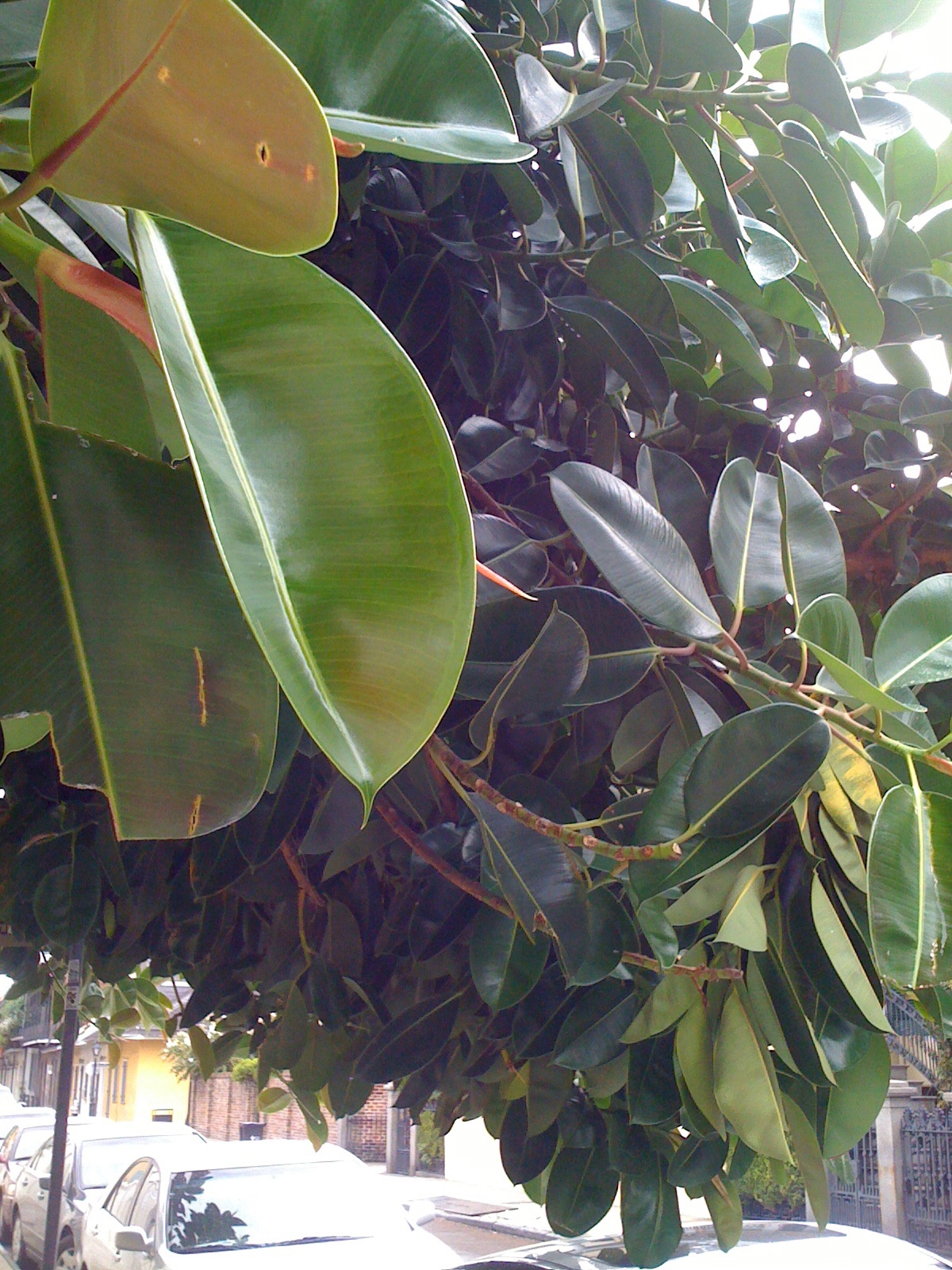
I looked up and noticed no rubber tree.
This rubber tree had been incredible. It had hung over the sidewalk, offering a bit of shade to sweaty tourists and greenery to sidewalk kings and queens for many years. Clearly, the cold air from last winter had done the tree in.
After picking up my food (drunken noodles with shrimp from Sukho Thai on Royal in the Marigny- I recommend), I clambered up the stairs to the Grand Duchess and her light-filled, warm rooms to ask her opinion on trees and to see if I could capture an idea or two about what to do. She made me at home and personally fixed me a rum and satsuma juice with grenadine and fresh lime juice. She always remembers the seasonal drink I choose although she added the grenadine. I like it better.

Can you tell me your thoughts on how we can re-tree the Vieux Carre to make it more shady or livable?
We prefer to think of the presence of trees as their own reward.
(I put my drink down carefully and focused my words.)

Pardon me, Duchess. Will you share some ideas as to how we can encourage tree planting?

We believe that the staff on Loyola Avenue should decree Dec and Jan as Tree Planting Months. Encourage it, offer tips on how and what to plant. Allow any fruit bearing tree or small root tree to be planted in dirt already existing on the edge of the sidewalk, or in the (aside to me with a wink) 1980s garbage inserts that you cleverly wrote about. (author’s note: I had written about the old cans built into the sidewalks that had a short life but still could be seen along some sidewalks in the Quarter. Somehow, she had read or been told about my piece.)
It would also be beneficial to add trees to balconies. These would be small trees in pots that birds would use to rest in and bring their songs to the mornings.
We would also encourage our people to add larger trees to their courtyards wherever possible, remembering the fig trees and orange trees and persimmon trees among many others that could be found throughout the village in the near past. We would also ask the staff on Loyola to offer a small metal bench (1.5 feet long, no more) for any area planted with 2 or more shade trees. The bench would be embedded in the concrete and encourage sitting by passersby or for the store owners who enjoy gazing despairingly at non-shoppers on their streets.

Certainly encouraging people to add trees is wonderful, but why should they go to the trouble?
We believe that trees have their own reasons for existing, but also exhort the citizenry to remember the satisfaction of plucking a plum on one’s way to the Cathedral, or to think of the delight that comes with knowing that full shade lies just ahead on one of our sultry summer days that will come.
Furthermore, we are an agricultural people and we believe that our village should represent the best of every part of what our region has to offer. Think of having a satsuma on Saint Ann or a pecan on Barracks. What is more appropriate for the old city?
It is true that many fruit trees leave debris that can be distasteful to those with the most gossamer of sensibilities, but for those without the passion for picking, ask your nearest restaurant if they would like the choicest fruit. When you find that intelligent chef, simply allow his most industrious staff person in to pick and find your favorite dessert made with your offering waiting for you when you go in to dine. Or toss the key down to the pie lady and offer her the prize. If no one takes your offer, have a party at harvest season and watch the fruit disappear along with your liquor!

She then walked with me down to her courtyard. She pointed out her favorites with her cane as she called some of their Latin and some by their New Orleans or everyday names: her beautiful Fortunella japonica, Citrus reticulata (she had been the one to introduce me to this favorite of mine actually), her Eribotrya japonica, (almost 20 feet high), her Fiddle-Leaf Figs, her bananas (edible and tasty I can vouch for that), her old Ficus elastica (she murmured it was related to the St. Mary tree knowing it would comfort my loss), pomegranate shrubs, and her Sago Palm and various others palms that I only barely recognized, all as gnarled as her cane. With the lights strung between, and with her climbing roses, larkspur, butterfly weed, bougainvillea, narcisissus, butterfly lilies, camelias (like few people had seen in generations), jessamine, red hibiscus, four-o-clocks in every color, it bloomed year-round and smelled–
well it smelled of New Orleans, really.

Ursuline Convent rubber tree circa 2009

Grand Duchess talks about graffiti

Tags on historic buildings are often quite shocking. The effort that is takes to rid some of it is expensive or even damaging to the surface, especially when lunatic fringe vigilantes take it upon themselves to spray industrial strength paint across the tag, often larger or messier than the original work. Of course, the difference between tags and graffiti should be understood, although I understand to some it is one and the same.  Tagging does seem to be an issue once again in the French Quarter, and since I have been so successful lately in getting good quotes from the Grand Duchess of the Vieux Carre, I called on her again, with felt pen in hand this time.

Here are her surprising thoughts:

What is your take on the war against graffiti in the village?
We are against war.

Do you mean you AGREE with graffiti?
We do not agree with any idea every time.

Do you like graffiti?
We appreciate artistic expression, activist tendencies and personal responsibility.

Hmmm. (I pretended I understood, but realized this was a never-ending tangle. I decided to take another tack):
Have you seen “informal artistic activity” that you appreciated?
We will assume you are referring to the practice of painting an expression on a building that one does not currently hold title. We have.

Have you seen informal artistic activity that you disliked?
We have.

Do you have any decrees that would answer this quandary?
We believe that half of available advertising space (excluding our village’s stores and their signage) should be designated instead for informal expression. The Staff may ask that it is limited to what does not incite violence or frighten children beyond a reasonable amount expected in this harsh world. We would suggest they ask artists to do their best to illuminate the public conversation, and not demean it.
Any artist who is then caught using a non-designated area to express their view should expect to be treated as outcasts by the village’s citizens and be asked to provide a number of hours for non-artistic community service to clean up after these offenders.

Duchess, may I say this is a surprising and probably polarizing view-point. May I ask how you arrived at this viewpoint?
We explain thusly:We have many friends in many different careers. Some are archaeologists, some are historians, some are tradesmen. The tradesman we use for stonework recently explained to us that work on the Giza Plateau in far off Egypt recently uncovered the graffiti of the original work gangs scrawled across the upper most chambers, (chambers that were never meant to be entered, which may have only been included to relieve the tremendous weight upon the main chamber). This graffiti has been able to answer some of the most important questions our modern world has of its predecessors in the desert. These work gangs’ tags allowed the world to understand the craftsmen who were not slaves at all (contrary to many years of history lessons) and instead were paid workers. Yes, questions remain of the graffiti’s veracity, but we are refreshed by the notion of workmen spelling out their pride. We also understand that many steelworkers and painters and other skilled workers do this, and think is an excellent way to sign one’s work. Additionally, activity that tells of impending clashes can be understood earlier; artists can illuminate an issue in this manner.

Banksy in New Orleans post-Katrina

Banksy in New Orleans post-Katrina

Knowing we had reached the end of the interview, I stood, quietly capped my pen and thanked her for her time. As I opened the door, the Duchess handed me a lovely old book, murmuring that it was for me. When I made it to the street light at her corner, I saw it was a lengthy translation of graffiti found in ancient Pompeii.

I

Grand Duchess addresses trivial questions

For those who read this little blog from time to time, you will notice that I enjoy introducing you to the great many people who use the French Quarter for business or for a wide selection of diversions or those who call it their home.

One that I met many many years ago is the Grand Duchess of the Vieux Carre. I do not remember when I met her, only that my friend Roger Simonson knew her and had a deep admiration for her. He introduced us (quite formally as I remember now) one summer evening when we went to her building before going to dinner at The Steak Pit down the street. We were charmingly introduced to all of her beautiful cats (we were told that all were named after Roman generals or burlesque dancers) as she led us through her rooms showing us her incredible collection of 1920s erotica which seemed to include some self portraits. I saw her after that from time to time, but had not spoken to her since Roger’s untimely passing. When I returned to the area a decade or more ago, I received a note in the mail at my mother’s welcoming me back home. I have no idea how she knew.
With some questions about how things have been running around the Quarter, I recently tramped up the rickety wooden stairs to the Grand Duchess’ airy rooms to ask about her feelings on festivals in her village (as she is also known to call the Vieux Carre), and was granted the right to publish her “decrees” as she terms them. As it has been a great long time since her public had heard from her, many questions have arisen about her and her official status since the first post.
So, I once again trudged the circular, slightly dusty stairs to see if she felt it was important to attend to the public’s perception of her. She listened carefully to my thoughts on the subject and asked me to return to her door in a fortnight’s time.
After looking up fortnight up on my iPhone, I agreed.
We sat with paper and pen (she allowed me to use a ballpoint even though her views on them are well known) while I fired questions. She often drank from her creme de menthe slowly and gazed out the window with what seemed to be a great deal of interest. It turned out she did that only when she had decided not to answer a particular query. Took me a bit to figure that out, so this short interview took half a day and almost a full bottle.
What is your full title?
We are known as the Grand Duchess of the Vieux Carre. Not the “French Quarter”. We can be called Duchess informally.
What are your responsibilities?
We serve the people of the Vieux Carre as we see fit.
How long have you been Grand Duchess?
(Drinking, window gazing here. )
Will you be offering more guidance in the form of decrees?
What other form is there?
Do you think the French Quarter is managed well by the staff of Loyola Avenue? (DW: “The Staff or paid staff of Loyola Avenue” seems to be what she calls City Hall ) finally deciding after a great deal more drinking and gazing and long silence that she would not answer any question formed with “French Quarter” in the question, I rephrased:
Do you think the village is managed well by the staff of Loyola Avenue?
We do not think “being managed” as you term it (with a impish nod towards me) is in the best interest of my people. We do not worry about (or for) The Staff on Loyola Avenue, although we wish them good health and wisdom.
Will you meet with the Loyola staff?
The only meetings that matter are chance and clandestine ones.
How will they know what to do then?
If they commit to honoring all personal expressions (up until it negatively affects another) they will know what to do. If they employ clear thinking and direct communication with as many of my people as they can stand before making a decision on their behalf (and follow my directives) they will succeed.

As I had clearly been granted a great many answers without too many uncomfortable, lengthy pauses, I thanked her with a nod (or maybe it was even a bit of a bow). With that, I clicked close my ballpoint (earning a slight frown from the Duchess) and left her to the twilight and her many cats.

Festivals-How the Grand Duchess would fix this.

Went to the Fiesta Latino yesterday at the Mint. Totally uneven attendance from side to side and vendors with items to sell were without customers. Food vendors were kicking ass, but no one else was (from what I could see).
As a result of this mess, I have consulted my good friend the Grand Duchess of the Vieux Carre. She told me long ago that she took the title of Grand Duchess out of respect to the queens already ruling their small nations around her, not daring to try to rule as a Queen in her own right- too many pretenders to the throne there.

After deep listening, insightful questions and careful thought (while sitting in her courtyard among her fig trees, and many, many cats) here is what she has imparted to me that she would decree. She has also asked me to tell the “officials” (she is not sure who that is but assumed I was aware of how to contact them) that the paid staff of the city would do well to enact her decrees if they wanted to maintain her good support and provide for her citizens.
Festivals are to be on Sunday (and maybe Monday if a second day is necessary) and not on Saturday.
Not that we, Grand Duchess, HAVE to explain.
However, we explain thusly:
Saturday is already a fabulous walking and visiting day for the FQ. No need to embellish.
And Monday is the slowest day- some locals can take the day to see the festival on a quieter day or come in the afternoon. Some tourists are still in town, they can go to it then. Everyone does not work 9-5 Monday to Friday. It’s crazy but it will probably work.

Start all festivals at 12 noon, run them til 7 pm.
We explain thusly:
If everyone knew exactly when they started and ended, everyone could tell others when asked or know what to plan for each and every time. Ask yourself how JazzFest continues to work with such a complex schedule. Because you know when it starts, when it ends and how each stage works.

All festivals will be held either on the Riverfront (with 2-5 music stages) or at the Mint (with 1 stage only on the Esplanade side) or on closed Bourbon and Royal streets with 2-5 music stages carefully set in areas that can handle the noise and crowds-300 block of Bourbon in front of Royal Sonesta, 500 block of Bourbon (it’s quite wide and stages could be on the hotel side), 400 block of Royal (on Supreme Court side), 700 block of Royal (in front of A&P/Rouse’s), and in alleys of Jackson Square on Royal side. Or on Royal anywhere after 7 pm.
We explain thusly:
We do not want to crowd out the stores and businesses that need access to their front doors and to be able to hear and move about. The point of the festival is to draw people to this area to shop.

The festivals will not have alcoholic drinks to sell, EXCEPT on Riverfront and then only beer.
We explain thusly:
Drink sales are to the bars of the French Quarter what milk is to a baby. Necessary and nourishing.

All vendors of said festivals will be operating primarily as businesses within the state of Louisiana.
We explain thusly:
Regional businesses will start to come to the city to vend and then maybe open shops or add products. This will help our city and our region, reducing the amount of division between outlying areas and the city. This is exactly what our fellow citizen Jane Jacobs taught us:
Cities are to provide resources to the outlying areas.

The festival organizers will provide a budget before and after to the vendors, the businesses surrounding the festival and post it publicly after the festival. What was spent and on what, what was made in income.
We explain thusly:
We all have to pay the piper sometime.

Vendors of said festivals will pay a percentage of sales to the festivals, not a flat fee. As it is the goal of the festival to build sales, the organizers make money when the vendors make money and do not when they do not. A simple small percentage will be paid and it will be done on an honor system. There will be mystery shoppers and tally takers who will be casually watching sales and making sure vendors keep a hashmark or receipt system. If anyone is suspected of supplying false numbers, they will not be invited to vend at any festival in the future. We will assist anyone with a receipt system if they are unsure of how to tally sales.
We explain thusly:
The vendors who truly want to sell an excellent product will work with this system. Those who come to sell crap or not account fairly, are not the type of artists that we want to work with in our festivals. It will benefit all.

There will be a revolving committee-artists, musicians, students of high schools, professionals (like lawyers, real estate you know leading citizen types that people every week of the society page), single moms, seniors, neighbors, non-profit organizers- of no less than 5 and no more than 11 advising the organizers. They will serve for 2 years and then cannot serve again for 6 years. They will receive free coupons for food and/or entry, a certificate given to them by the City of New Orleans and a dinner of their choice at any FQ restaurant at the end of their service. They must attend 80% of the meetings in person and volunteer 4 hours per year at one of the festivals.
We explain thusly:
Democracy is messy, chaotic and useful.

Staff of the festivals must be dressed with the official black and white of the classic waiter look and have a badge worn all of the times while on duty. The clothing particulars are left to grouo, but black pants or shorts with a spotless white top is necessary. We would also like to see an apron (or a lovely bow tie), but we will not decree this at this point.
We explain thusly:
This is the professional gear of the French Quarter. It is instantly recognizable and quite useful as a uniform.

All stages will either pass a locked tip jar (much like the baskets with arms passed in big churches) and/or designate an area to allow musicians to sell their cds directly or bring someone to sell them. If cds are to be sold directly, there will be a 30 minute gap between acts directly right of the stage that will be for cd sales. The musicians will be paid per person by doing a head count (done every 15 minutes and the largest one count taken) that they turn in (someone can do it for them if needed). Much like the vendors, they will be sporadically counted for veracity. Panoramic photos will be used by festival organizers when checking.
We explain thusly:
The door is usually the way that musicians are paid and since some work hard to get their people to the events, they should benefit. The tips and cd sales are all theirs too.

We do hope my laws are enacted fairly and clearly as they were intended.
Grand Duchess of the Vieux Carre (given verbally to her faithful friend, Dar Wolnik)*

*The territory of a grand duke is referred to as a grand duchy. The feminine form of grand duke is grand duchess.
Translations for grand duke include: in Latin, magnus dux; in Spanish, gran duque; in Russian, великий князь (velikiy kniaz); in German, Großherzog, Italian gran duca; in French, grand-duc; in Portuguese, grão-duque; in Finnish, suurherttua; in Polish, wielki książę; in Hungarian, nagyherceg; in Swedish, storhertig; in Dutch, groothertog; in Danish, storhertug; in Lithuanian, didysis kunigaikštis; in Czech velkovévoda or velkokníže.

A duchy, is never referred to as a dukedom, is a territory, fief, or domain ruled by a duke or duchess.
Some duchies were sovereign in areas that would become unified realms only during the Modern era (such as Germany and Italy). In contrast, others were subordinate districts of those kingdoms that unified either partially or completely during the Medieval era (such as England, France, and Spain).