St. Mark’s Methodist Church

Upon entering the Quarter via a left turn from Rampart to Gov Nicholls, one usually has eyes up ahead rather than on the corner. But if you happen to look to the right after turning, you would see a Spanish mission style church from the side and back. As to why the Methodists built it in that style to serve Italian immigrants, is unknown. From St. Mark’s website:

Following the settlement house model, Methodist women moved into a neighborhood to live with and assist people in need. They selected the name, St. Mark, the patron saint of Venice, Italy, as a gesture of outreach to Italian Catholics who dominated the area at the time. An emphasis on outreach, empathy and cutting-edge ministry has characterized St. Mark’s ever since. The current church at 1130 North Rampart, at the edge of the historic French Quarter, opened in 1923. In its hundred-year history, St. Mark’s has experienced many “firsts.” In the early twentieth century, people from over twenty-five different nationalities participated in St. Mark’s programs. In the 1930s, St. Mark’s offered health and dental services that were open to people of all races and ethnicities. The Community Center operated the first indoor pool in the city, also integrated. The church and community center fully integrated in the 1960s. Its pastor, the Reverend Andy Foreman, was featured in international newspapers as he walked with his daughter Pamela to one of the first integrated elementary schools in New Orleans. In 1973, a horrible fire resulted in the deaths of twenty-five people in a gay bar, the Upstairs Lounge; no church in New Orleans would hold a memorial service for the victims. St. Mark’s stepped forward, and opened its doors.

(as to the memorial after the fire at Upstairs Lounge, historians of gay New Orleans remember it a bit differently:

Only one member of the New Orleans’ clergy, The Rev. William Richardson of St. George’s Episcopal Church, was brave and GOD loving enough to immediately hold a service for the victims of this horriffic event and their families. Almost a week later, St. Mark’s United Methodist Church allowed Rev. Perry to hold a memorial service.

excerpted from http://www.gayworld.net/memorial/

The poor who lived in the French Quarter through much of the 19th and early 20th century have been served by a number of missionary types.

In 1727 twelve women — Ursuline Nuns from France — established the first school for girls, ran the first free school and the first orphanage and held the first classes for African slave and Native American girls in what is now the United States. The Ursulines still serve New Orleans (from their Jefferson Avenue campus and girl’s high school) and are are believed  to keep hurricanes away from the city by praying to Our Lady of Prompt Succor. When Katrina hit and word came that the Ursuline nuns would be evacuated, many felt it was a very bad sign. Upon returning to the city, the Mother Superior was interviewed on NPR and asked to explain why the prayers were unanswered in 2005. She answered that the damage was a engineering disaster caused by the federal government and not a natural disaster which is what her nuns have prayed away for almost 300 years.

Our Lady of Guadalupe is another site still in use to serve the poor (like St. Mark’s). (from http://www.neworleanschurches.com/):

Our Lady Of Guadalupe Church is actually the oldest church building in New Orleans. Saint Louis Cathedral is often thought to be the City’s original church, however, the Cathedral building was rebuilt during its lifetime.  The building known as The Mortuary Chapel of St. Anthony Of Padua, is located on the corner of North Rampart Street and Conti. It dates from 1826, some 25 years before the present St. Louis Cathedral was constructed.  Although the church had been temporarily closed a number of times in its lifetime, it was many things to many people.

During the span of almost two centuries, The Mortuary Chapel was first constructed to hold funerals of Yellow Fever victims. In the era predating modern science, medical practitioners once believed that Yellow Fever could be spread by exposure to the dead or by transporting the dead through the city streets for burial. The Church therefore banned burials from St. Louis Cathedral and a mortuary chapel was established close to St. Louis Cemetery, the main burial location for most of New Orleans Catholic families.

The community center on the river side of Conti and Rampart is still very active.

St. Mary’s is located next to the historic Ursuline Convent (considered by some to be the oldest building in the city). St.  Mary’s  served the Italians who populated much of that part of the French Quarter during the first half of the 20th century after serving other ethnic groups at various times.

Settlement houses abounded in the U.S where “settlement workers” lived among the poor they served- Hull House in Chicago was the most famous and its founder Jane Addams was a mentor to many including Eleanor McMain, who ran Kingsley House on Constance Street for many years and made it a center of innovative programs. Kingsley House  is the oldest settlement house in the south and is still active in the lower Garden District.
Plantation Style Architecture

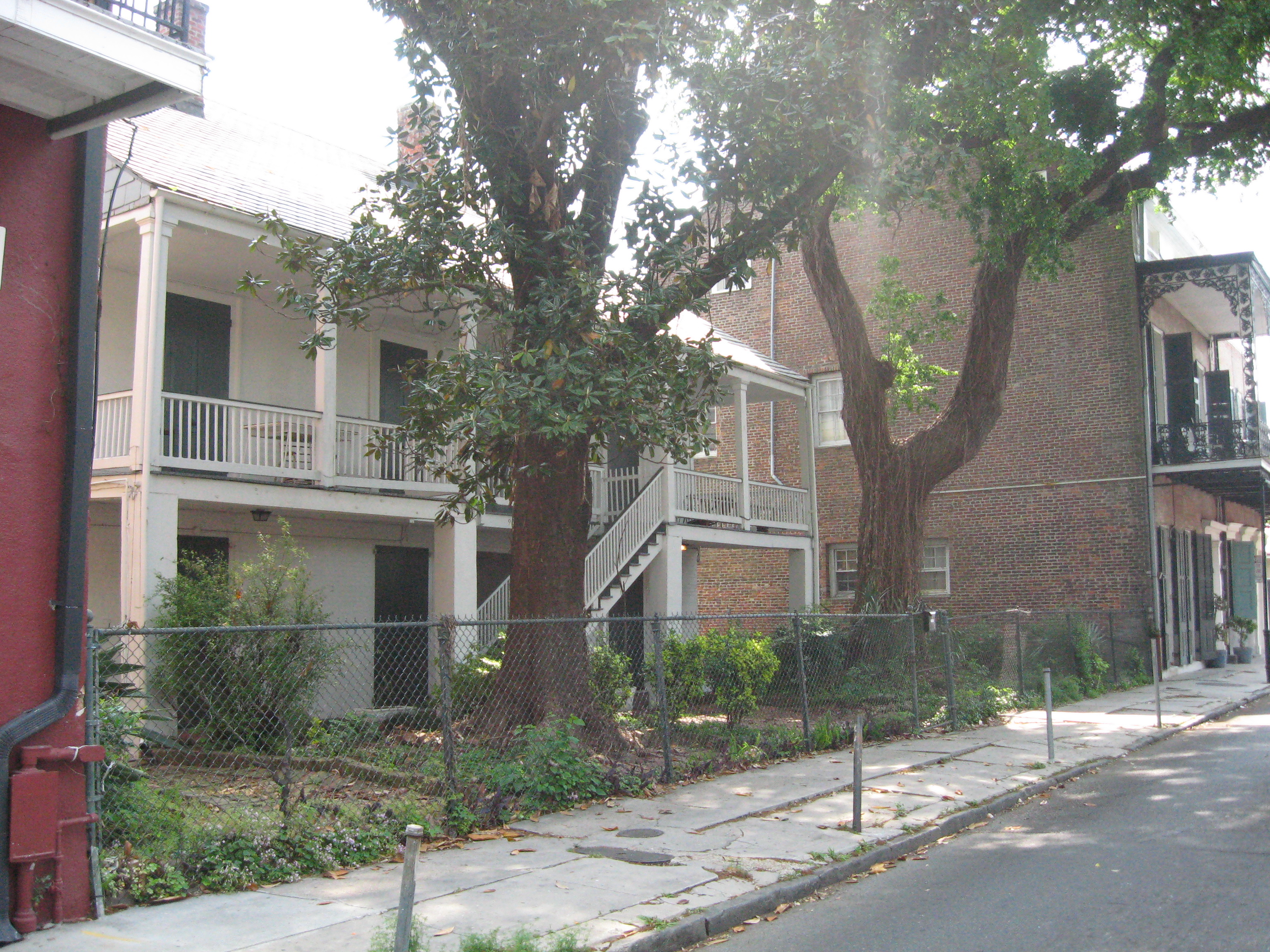
Governor Nicholls 900 block

These were built in this style to minimize the effects of heat and flooding that were common in areas near swamplands and the Mississippi River, and  are generally raised on piers to stay above flood waters.  There is often a large central hallway to encourage air circulation and the galleries or porches wrap around the house and are usually very deep — providing shade in the summer, keeping the sun out of the house and creating comfortable outdoor living space.This house has an amazing amount of space around it in front, unusual for the French Quarter. According to the fantastic book “Along the Banquette”, it is the same house moved from Gabriel Peyroux property on Bayou St.John, to the “city” in 1781. If so, this makes this house one of the oldest in the city.
Also, the width is also unusual, as back in French rule,  taxation depended on the width of your house not the length. The camelback style (2 story living area rising from the back of the house) is often seen as a direct retaliation to those tax laws. Interestingly, after some taxpayers complained about camelbacks having lower taxes than they, the assessment was changed to the number of rooms in each home, which explains the lack of closets  and the use of armoires which continues to this day in many areas of New Orleans.

Plantation-an interesting word that should be explored more fully- It is often said that we resemble the Carribbean more than Europe and certainly the economic underpinnings do match- exploiting the few resources and having the few control the many is similar.

Plantation life is often told as a rosy time of entrepreneurial activity with its own culture and traditions, but certainly the grim reality of enslaved people doing the work needed and actually bought and sold as  property must be remembered as the main engine that ran this entire area. Remember that when you see “slave quarters” advertised as rentals, or walk by Maspero’s “Exchange” on Chartres that the history of slavery and subjugation does permeate the 1800s of New Orleans.

Marcello Properties

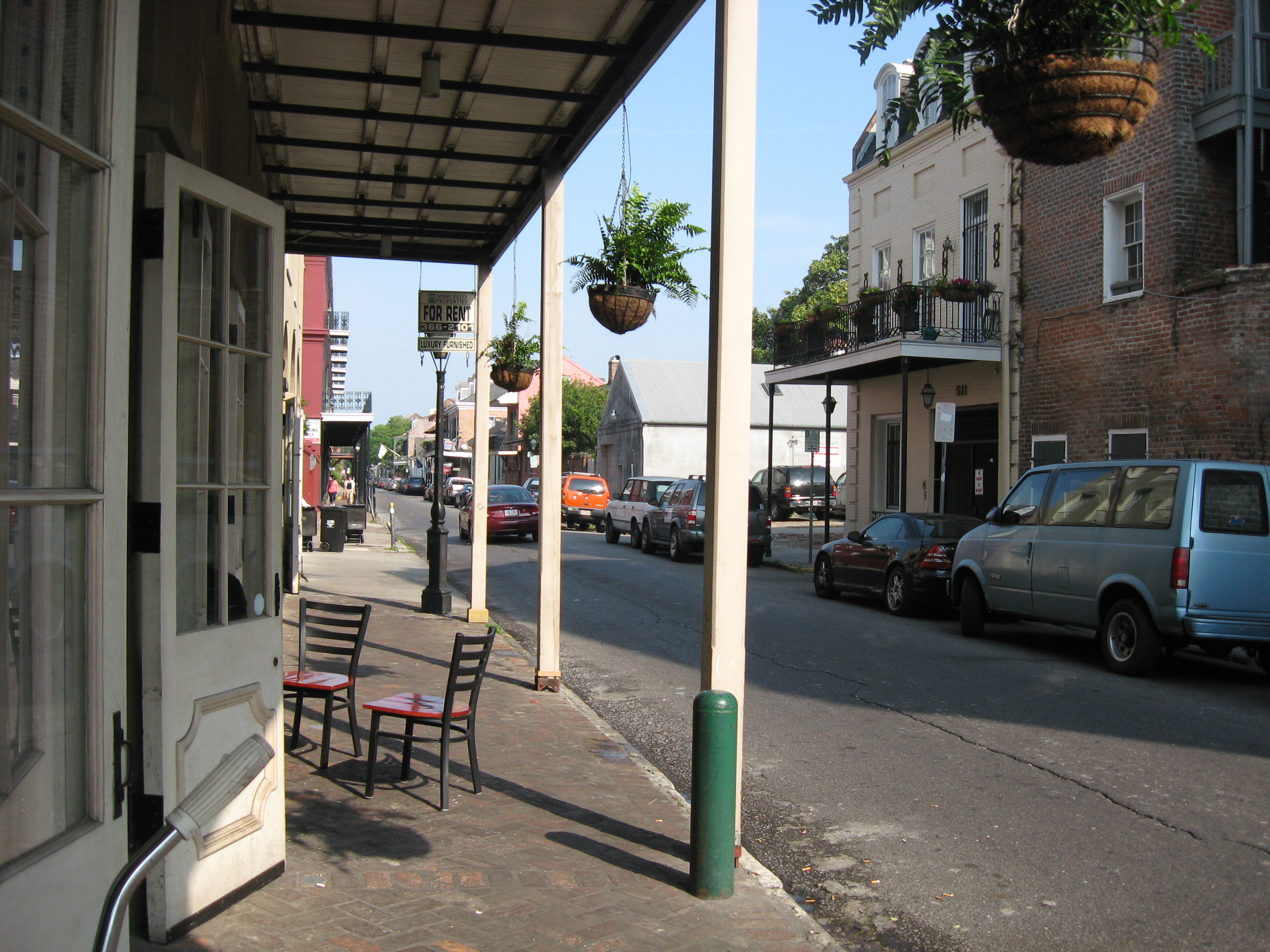
Cafe Envie, owned by Marcello Properties

Carlos Marcello: Big Daddy In

The Big Easy (excerpt)

By the late 1940’s, Carlos had established his headquarters in a bar and restaurant that came to be known as Willswood Tavern. It sat on Highway 90, about fifteen miles west of New Orleans on the West Bank in Jefferson Parish. He would hold court here, meeting up with the men who ran his empire, dispensing justice to the unruly. He owned 6400 acres of swampland that spread away from the inn with lots of unique and handy bayous to hide bodies. After business, he would entertain his people on a lavish scale. A man with a gargantuan appetite, he imported a chef from Chicago, an ex-convict who had apparently been the personal cook of Al Capone. His name was Provino Mosca and his Italian cooking became legend in the area. Carlos built a small house near the tavern for the chef and his wife and son, and when it was time to move his head office elsewhere, Carlos left the tavern for his chef to continue operating under the management of his mother Louise, who by now had become widowed. Today Mosca’s son John runs the business know as Mosca’s, at 4137 Highway 90, Waggaman, producing food equally as delicious as his father did before him. Their two crab salads, garlic shrimp and chicken [a la grande] is food to die for, which not doubt may well have been the case fifty years ago for some of the visitors to this tavern on the green.

His illegal capital funded motels, restaurants, banks, beer and liquor stores, taxi and bus firms, shrimping fleets, gas stations, the list was endless. He claimed however, that he was simply a salesman for the Pelican Tomato Company and earned $1500 a month. On paper he was, and the fact that he also indirectly owned the company, whose biggest customer was the U.S. Navy, was incidental.

Carlos Marcello, owner of a tomato company and considered the Godfather of New Orleans crime was convicted on federal charges in the 1980s although the convictions were later thrown after he served over 6 years. He retired to old Metairie and died in the 1990s, with property throughout the French Quarter and regional area still under the family control.

Muffalettas and catfish

Serious question: is there good food to be found in the French Quarter under 10.00?

Answer: yes.

Today, I went to the French Market to buy chopsticks ( I also buy my sunglasses, luggage, wallets and a few other things, quite a useful place when you get over the longing for the lost farmers market there) and when I left, I walked down Decatur to Central and got a half muffaletta, then scootered to Matassa’s for baked catfish, baked mac and green beans.

Took them both home to divide up into meals, and I have probably 4.5 meals here.

7.63 at Central

9 something at Matassa’s.

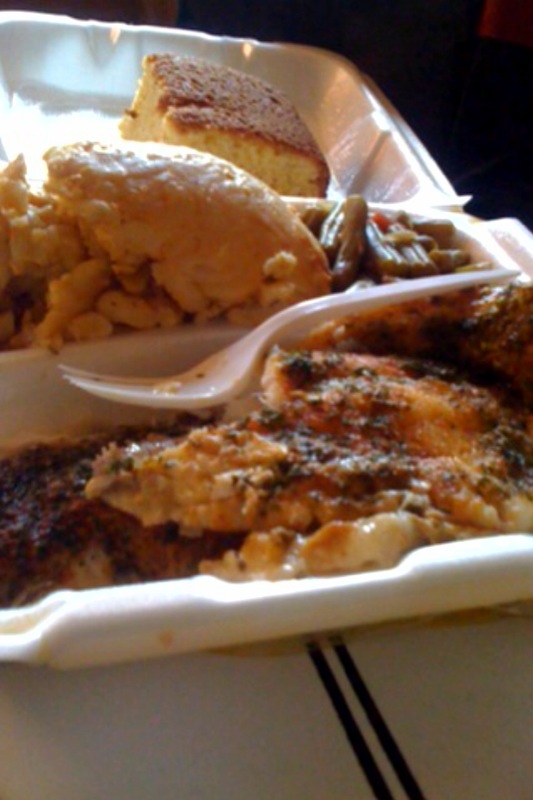
catfish looks great (see picture) and seems like 2.5 meals to me, based on past experience with their food.

As for the muffaletta, I will take a quarter when I go kayaking and sitting on bayou st john tomorrow with a beer and that sandwich with my feet up. the other quarter will probably be lunch on Sunday with another beer, after gardening.

All done in the lower Quarter, which means parking along the levee/Mint.  Dodging the slow folks on Decatur and wondering who all those crazy ass people that are sitting in bumper to bumper traffic on a beautiful day, instead of walking from a few blocks away.

2.5 meals from one order of baked catfish, baked mac and green beans.

Excerpt from “A Friend in New Orleans” 1992

A great memory from an unusual travel book:

“Kaldi’s Coffee House and Coffee Museum

941 Decatur Street     568-8989

Open Sunday-Thursday 7 am to midnight

Friday-Saturday 7 am to 2:30 am

One of New Orleans most aromatic experiences is the stimulating fragrance of roasting coffee beans. Read the paper and rest your feet in this slightly counter-culture haven, while sampling an inspiring array of pungent brews. Their museum of coffee memorabilia is worth a look.”

I miss it still, but am glad for offspring Fair Grinds in MidCity!

Along the Banquette: French Quarter buildings and their stories

I recommend this odd little book on specific houses in the French Quarter. Written as individual columns for the neighborhood paper in the 1960s (and heavily edited for the book),  it made it to publication because friends and colleagues of the author, who were mostly members of the VCPORA, the leading  neighborhood association in the French Quarter perservered over a period of years to get it done.

It’s exactly what I like: idiosyncratic writing, charming drawings and no obvious reason for its selections of subjects. A meandering of the old city as it should be.

Found at Historic New Orleans Collection shop-lovely but a bit nerve racking to visit if you have large bags or quick children. Both should be left at the door with the hope that they are still sitting placidly when you return.

Do let the fine ladies at the register know (quickly) if you are a member and deserve the discount; seems they are afraid to assume some of us grubby Quarter Rats might have a membership card!