Well that would explain those crazy people I see from time to time, sprinting and or skipping while yelling “it’s here!” (Alas, I thought it was over my cheap drink map…)
Author Archives
review: City Life
 City Life: Urban Expectations In A New World by Witold Rybczynski
My rating: 4 of 5 stars
I liked Rybczynski’s book “Home” which observed how comfort, family life, privacy, efficiency (damn those Victorians) and work have shaped the idea of home.
“City Life” is an excellent overview of how Americans have evolved the modern culture of cities which remains one of our few last exports to the rest of the world.
He makes many useful observations:
The evolving definition of city, or town or burg. The word city comes from towns that had bishopric seats, and had nothing to do with population. In general, it had religious connotations. gulp.
That Americans simply brought their urban culture to the rural communities. Therefore, it follows that we don’t have the parallel cultures that much of Europe has still but instead share more within the building blocks of each community.
Maybe there is hope for us.
Unfortunately, I think much of what we now share across the nation starts with American Idol and ends with WalMart.
That many universities were built by architects as self-contained towns with a rich patron to bankroll the ideas and had little or no opposition to their ideas. That made me pause; since almost all architects and planners come from those environs, it occurs to me that their last experience of village life before designing them are these mock towns that believe wholeheartedly in the built environment and most often in a sort of medieval spires and green field view of life.
Uh oh.
But the most important part of this book for me is his chapter on housing for the poor and the great migration (great meaning whole bunches) of African-Americans to the Northern manufacturing areas. As we need to remember, the post war boom was basically over by the mid-1960s and yet no changes were made in the policies of the US for those who migrated to where the jobs once were. Housing for the poor reflected that missed opportunity and still does.
I wish this part was longer but at least he attempts to add it to the conversation. That accessibility is still the main reason for city life I agree with but not sure that I agree that with wireless accessibility, fewer physical cities may need to exist. That may be true, although I feel that theory has been preached since the 19th century (and its advent of the ” annihilation of time and distance” with the invention of the telegraph, railroad and photography) yet cities continued to grow in importance and size in that very time.
I also wish there was more on the immigrant experience and how it has changed in America and therefore changed cities too. I know that in my own city newly arriving immigrants are now moving to the suburbs of Jefferson Parish as soon as they arrive and not to the city center which worries me. I’d like to hear some perspective on that.
Rybczynski writes well for a wide audience and gives concrete examples of places that illustrate his points.
You can do worse than reading this primer, especially if you are new to the subject or prefer less academic views of heavy subjects, like me.
I guess I have to explain it.
When I was 15, my mom moved me to the French Quarter from suburban Cleveland Ohio (via a short stop in Mandeville). We had spent many summers in New Orleans and my mother, who had grown up in the Garden District, seemed to always find her way back to the Quarter when we came to town, even with the clear-as-bell disapproval from her parents. We never spent any time Uptown; somehow she had few memories of life there and less interest in showing it to us.
So, when we moved to the Quarter, she was in her own heaven and at the same time, loosened her hold on me, so it is pretty obvious why I initially liked being there. But soon I realized this was a special neighborhood of deep history and lively city street activity and that it suited me personally. I roamed every day and some nights and met shopkeepers, proper ladies, street-walker, schoolteachers, hustlers, nuns, old old people who sat on their stoops on sunny mornings, workers who told me gossip while they swept, artists who started the day with a drink at the dark bar nearest to their room, transient people who told very little about themselves and many more Herbert Asbury and Frances Parkinson-Keyes types.
I learned to have tolerance; that was not something that had been shown to me in suburban Cleveland, even though my mother heroically tried to overcome that culture with her own New Orleans attitude. I also learned about the entire city and its history both old and newer. Like the immigrants and states and nations and all of the companion events sweeping over us, as they do…
So I write about the French Quarter because I think it represents some of the best things about city life and has some fractures that, if we mend them, we could once again have a completely dynamic city center that everyone uses at some point.
So when a colleague this week said with a laugh (about the French Quarter) as we were discussing neighborhoods , “Oh that’s not real New Orleans”, I heard it with a pang. I realize again and again when I tell people I am writing about the Quarter, many think why? How is that valid?
I think it is for the reasons above and for these:
Small businesses are the real life of any region; they show ingenuity and application in a single space. I learned about what we made and what we valued here from watching those businesses.
Food is a significant part of our city diary. Check out the offerings that span the culture in that one neighborhood.
Conversations teach: Sit in a spot in 3 or 4 different times in a single week. You will see a cross-section of the city go by and hear some amazing conversations.
24 hours, 7 days a week. It has that going for it.
Public space is necessary: Tahrir Square showed us the significance of the use of public space. We may never have to resort to that (well let’s not say never), but our public square is around 120 blocks large and sits along the river, waiting for you to use it. If and when you need it.
As for tourists, they are some of the lifeblood of the city’s economy along with the port. I know almost nothing about the port, but I talk with America and share thoughts and disagreements constantly as they come to admire our city. I wish we had better things to offer in the Quarter for all of us to mingle and know each other, so that is also why I work to make it better. And don’t forget many of those tourists are interested in more than beads and hurricanes, they might actually offer something. Lucky for us millions come to visit us.
And finally, because it’s the right scale. I can walk the entire Quarter in a few hours (and have done it many times). I can find parts that are quieter than City Park, livelier than Frenchman (well on a Thursday; nothing compares with Saturday there), more beautiful than St. Charles (age has its advantage), more radical than Bywater and so on. I don’t mean to compare but for those who ask why the French Quarter, I guess I have to.
Those blocks signify New Orleans, my own family’s history, my history, the bad and good of city life, and the potential, too.
I hope that helps.
Movies, 3
The Historic New Orleans Collection presents three screenings in conjunction with the exhibition Drawn to Life: Al Hirschfeld and the Theater of Tennessee Williams.
Sunday, March 13, 2 p.m.
The Line King: The Al Hirschfeld Story
An Academy Award-nominated documentary by Susan Warms Dryfoos, The Line King celebrates Hirschfeld’s many years of work for the New York Times, where his drawings were a centerpiece of the Sunday Arts section. With appearances by Lauren Bacall, Robert Goulet, and many others, The Line King is a fascinating portrait of the artist as a cultural icon. (1996; 86 minutes; not rated)
The exhibition will be open 12:30–4:30 p.m.
Sunday, March 20, 2 p.m.
The Fugitive Kind
Sidney Lumet’s stirring drama The Fugitive Kind (based on Tennessee Williams’s play Orpheus Descending) features Marlon Brando as a drifter who wanders into a small town in Mississippi and falls into a tragic love affair. Following the screening, Mark Cave, curator of manuscripts/oral historian at The Collection and co-curator of Drawn to Life, will discuss the film and the display. (1960; 120 minutes; not rated)
The exhibition will be open 12:30–4:30 p.m.
Tuesday, March 22, 6:30 p.m.
Journalist and anchor Eric Paulsen’s 1981 interview with Tennessee Williams
Noted news anchor Eric Paulsen conducted the final in-depth broadcast interview with Tennessee Williams in 1981, roughly two years before the playwright’s death. After the screening, Paulsen will discuss the interview and take questions from the audience. (1981; 47 minutes; not rated)
The exhibition will be open 9:30 a.m.–8 p.m.
Mardi Gras Day 2011 video
Eris parade
Even though much of the Eris parade situation did not occur in the French Quarter, it does have a bearing on it. In this first link, the organizers talk about how they rerouted the parade to not go to Jackson Square because they could sense the tension from the idea of downtown artists coming to parade in the old city.
organizer interview
Second is the video of a police officer telling someone to put the camera down while they were doing what a citizen should do:
Eris/NOPD
And lastly, the NOPD (including the 8th District) is in this paraders account of his arrest:
Eris parader account
All I can say at this point (as we watch to see how this unfolds) is that we all need to take a deep breath, count the many ways that the creative culture makes this city thrive and do what we can to support more dynamic artist activity in the French Quarter and nearby neighborhoods.
3 pictures from today
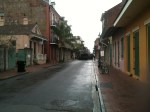
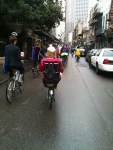
I think it’s impossible to capture the true diversity of uses on Mardi Gras day of the French Quarter. Let me just give you three very quiet ones from early in the morning: Very clean streets, a bike parade and the “best in show” award once again for house decoration in the Quarter.
Other than that, I hope you saw it for yourself.

 French Quarter block by block
You must be logged in to post a comment.